In New England Stood a College

Once upon a time, back in college, I sat in an acquaintance’s dorm room. The acquaintance was closer to my best friend at the time–they were both the same major–but I didn’t know her well. As we sat and talked, just small talk and gossip about the classes we shared, my friend brought up something in a hushed whisper: would the acquaintance tell anyone that she was an atheist?

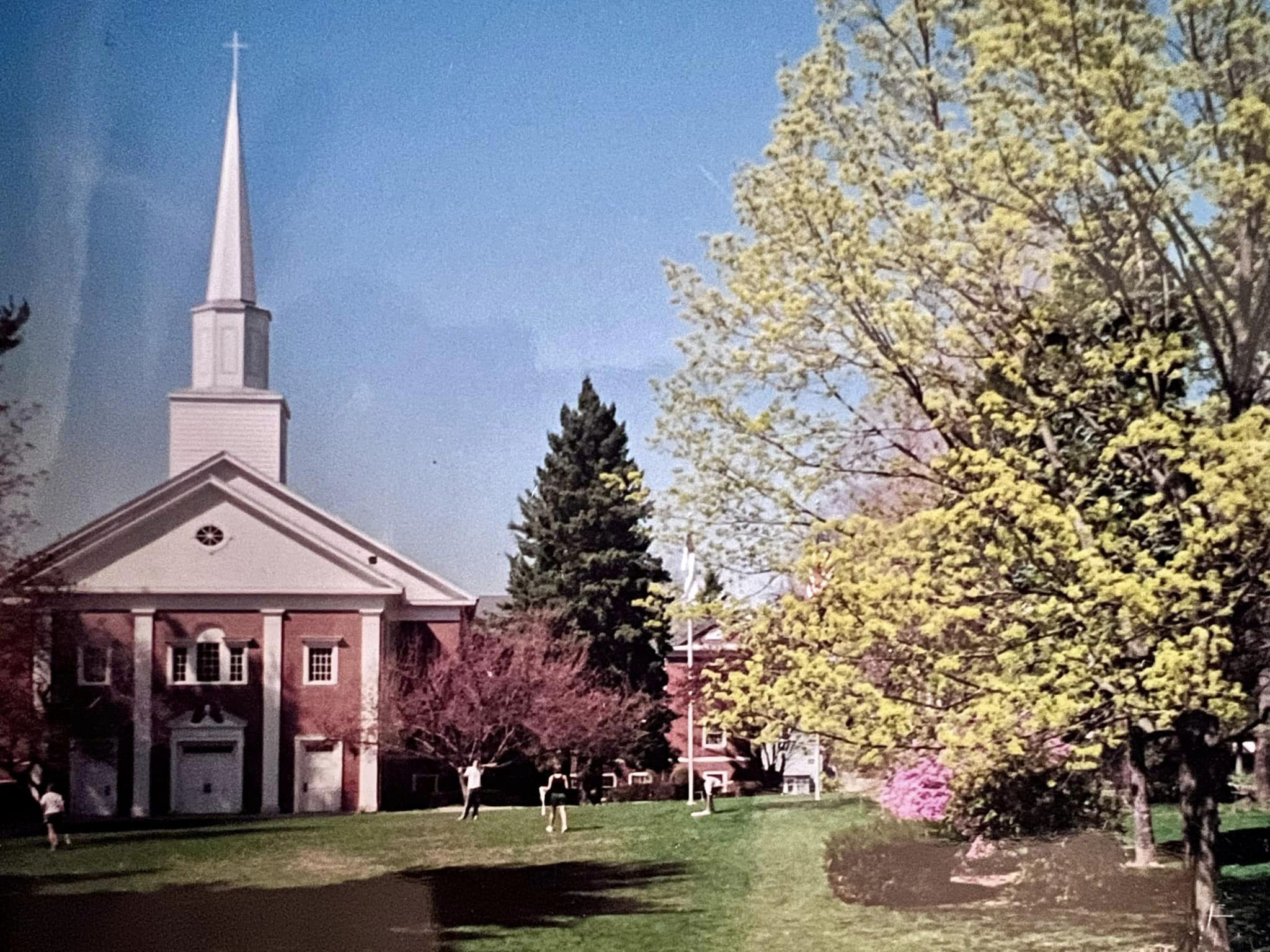
This might not seem like a huge deal, but the college I attended was Eastern Nazarene College, a conservative (for the region) Christian college just south of Boston. Faith was a cornerstone of attending the school; though it’s been nearly 25 years since I filled out the application, I’m entirely sure that you had to give a declaration of faith in order to apply. Daily chapel services were mandatory; lack of attendance meant heavy fines. A fair number of courses began classes with devotionals and prayers, the latter ubiquitous when it came to finals time. In addition to typical college rules about GPAs and plagiarism, ENC had strict rules when it came to student behavior: no sex outside of marriage, no drinking (even if you were of age), no smoking, things like that. A few years before I attended, the school had even stricter rules in which people weren’t allowed to go to the movies (they posted school officials outside all the local theaters) and certainly weren’t allowed to do things like dancing. Even if the rules had lightened up in recent times, the punishments hadn’t. The year before I started, the entire baseball team was expelled for drinking at a party celebrating their recent championship. 

The Abby of 2024 would not attend this school; I daresay, the Abby of 2024 would run away screaming. But the Abby of 2001…

I was raised in the church with all its baggage. In high school, I often felt quite alone even with my handful of friends–the beliefs I’d inherited from my church and parents made it often difficult to relate to my peers, but the fellow Christians in my school were often far more fundamentalist than I was. I occupied that strange space of 90s Evangelical kids, particularly ones in New England. We weren’t as fundamentalist as our fellows in other regions of the country (the fundamentalists in my school hailed from the DEEP deep south), but we were far more rigid in our thinking than our non Christian peers. It was a weird place to be.

So when it came time to choose a college, ENC seemed ideal. It was about an hour from my parents’ house, depending on traffic. It was a Christian school but not one that seemed more like a prison than anything else. It had quick and easy access to Boston. Best of all, it had a robust music and performing arts program. I remember seeing a play one visiting weekend and thinking, “this is it. This is where I need to be.”

(as an aside: while I was VERY involved in the school’s A Cappella Choir, I never once performed in one of their plays. A big fish in a little pond at home is very much a little fish in a big pond at college, even one as small as ENC)

And in the fall of 2001, I was. I started at ENC about ten days before 9/11, living just across Quincy Bay from Logan Airport, where the planes came from. My classmates and I walked candlelight vigils and sat in the chapel crying for days afterwards. I went on so many trips with the choir, from places as close as the next town over all the way down to the Panama Canal. I had the opportunity to study abroad at Oxford University (where I barely passed, but shh). I made many dear friends, fell irrevocably in love, pulled off crazy–and surprisingly sober!–college stunts. If I drove to Quincy now (a drive for which I wouldn’t even need Google Maps), I could walk the campus blindfolded. Give me a route, I could find my way without thought. There’s the TV lounge where I saw the second plane hit the tower, where I saw the Patriots win the Super Bowl for the first time, where I watched Mark Greene’s last episode of ER. There’s Cove, where I learned to really SING, where I felt part of a team–a family. There’s Williamson, the first dorm I lived in, the best freshman dorm I could’ve asked for. There’s Gardner, where I took all of my classes for my English major and argued before so many higher ups that I should be allowed to study abroad. There’s the church, where I spent so many chapel mornings trying not to fall asleep and so many late nights singing. There’s the green where I laughed and played football with my friends. There’s the puddle with the goldfish. 

And that’s all well and good and nostalgic but would also not be on my mind at all if the school hadn’t just announced plans to close.

I haven’t missed ENC at all in the years since I graduated (19 years now!), especially as gradual changes to the school stripped it of everything I loved about it. Not long after I left, my beloved A Cappella Choir ceased to be, and then a few years later, the English department was disbanded. Budgetary reasons, I’d assume. The school was having budgetary issues when I was there 20 years ago; according to the rumor mill (and every alumni email I’d received begging for money), those issues had only gotten worse with time. Beyond that, though, there was something strange about my small Christian college. Not bad, not necessarily, but something that failed me somewhere in there, and I think it was a form of stagnation.

Another alumnus wrote about this before I did, and his blog definitely inspired this, though he’s still a Christian and has more insight into the situation than I do or could. He agreed that ENC was caught between a rock and a hard place–too liberal for the conservative Nazarene denomination, but too conservative for a school south of Boston. My experience as well was that ENC was a place where you could only grow so far, because if you learned something about yourself that didn’t fit the good Nazarene mold, you could never really be honest about it.

Like the acquaintance who was an atheist. I don’t know if she ever told anybody. I don’t remember if she graduated with us. I hope that wherever she is, she’s really living her best life, no matter what she believes.

I’d realized I was bisexual before I came to ENC, but college was when I really grappled with it and eventually accepted that it was part of my identity and not some desperate sin that I could pray away. I can’t tell you how much research and digging and praying and self loathing and panic and all sorts of things built into that realization. And the thing was, I had to keep it under wraps. If I were honest about myself, I’d likely have been expelled.

There are a fair few of us, being completely honest. I thought about it the other day when a friend, who has since come out as bisexual, commented on one of my Pride memes on Facebook. Like holy shit, life would have been so absurdly different if we could’ve all been honest with ourselves and each other. Imagine the support group we could have built! Imagine us coming of age surrounded by love and support and community rather than by the pressure to keep ourselves under wraps.

Which isn’t only ENC’s fault. I don’t know where anyone was on their journey then; I, personally, only got to the point of saying I was “bi-curious” in college because of my beliefs. But still.

I also don’t mean to solely disparage ENC because I did make some really exquisite memories there, I did grow and discover more about myself as a person, I did make very dear friends, but I guess that it’s kind of half and half. On the one hand, good memories, good times. On the other hand, couldn’t wholly be myself. What a place.

The school sort of had a commitment to helping students grow, but not really. In 2005, I was taking an ethics class with a bunch of friends (one of the prerequisites for graduation), and we had to do this final project where we examined a controversial topic from both sides and came to our own conclusions. Several of us decided to do our project on abortion, but that caused a problem. See, the library only had one book that gave any information about abortion beyond “ABORTION BAD,” and that made it difficult to research the topic from both sides. And worse, the word “abortion” was blocked by the college’s filters, so if you–like me–wanted to actually get both sides of the issue, you couldn’t do so on the campus. 

Which, like. Okay. Pick one, ENC. Do you want us to actually look at the issue from both sides and come to our own conclusion, or do you want us to reach the conclusion you’ve already decided we should reach?

(for the record, a friend and I ended up going off campus to research, specifically to Planned Parenthood, and I wound up with a VERY high grade on the project–high enough to make up for me failing my professional writing class the semester before)

(additional note: depression and college aren’t a good mix)

In the end, that felt like a lie, like don’t actually grow, just fill the mold we have for you a little better. And on the one hand, that sentiment is pretty common in churches and Christianity writ large, and it’s not a wholly bad thing: when you grow as a person, you want to grow better not worse. You want to be good at crafts not good at hoarding craft supplies, for example. But on the other hand, we were adults who weren’t allowed to trust ourselves to figure out what was good growth and what was bad growth, and for some of us (me, I’m talking about me), that meant a rude awakening when we were finally out in the real world. 

I don’t know. I feel like that sort of “grow, but not really” mindset is what made ENC lose appeal so quickly. It had a lot of more liberal practices and classes, like a requisite science course taught by a man who’d written a book on how one could accept evolution as a proven theory and still be a Christian (at the time, I hated it, but now I’m like… oh. Oh.) (apparently, lots of influential donors withheld funds while that professor taught at the school, which like. Christians. I need you to accept that when you do this, people are not hating Christ in you. They are hating you for being assholes). That meant that students looking for a Nazarene college would probably go to one of their other schools, maybe in the south or the midwest (California if they really wanted to push it). 

On the flip side, ENC had pretty much no appeal to non-Christian students. How could it? Every class began with a prayer, every day was some form of chapel or worship, every course was through a Christian lens. And I’m not saying that it shouldn’t have been, but it absolutely felt like the school was trying to have their cake and eat it too. Trying to straddle that line ultimately was the cause of their demise, and really made my time there complicated to parse out emotionally.

The complicated back and forth feelings hit hardest when I returned to the school after studying at Oxford. Studying there was enormous when it came to experience, not just because of the freedom we were granted when not in class (because we lived on our own, and the culture of England was different enough from US culture that the rules we would have had at our home schools just would have fallen apart) but because the courses themselves were focused on opening our way of thinking about our faith and history. I remember one course that talked specifically about how archaeological evidence didn’t support the Bible being a historical document and asked us a question without an answer prescribed for us: if Jericho was not razed, is our faith in vain? There was no right answer. There was no expected answer. 

So it’s all. Very complicated. I have a lot of nostalgia and sad feelings, but I also have this sort of feeling of inevitability. Like this thing was trying to tear itself in half and finally managed, and it’s hollow, but it happened. 

I have my nostalgic pictures up. I have my reminiscing with my friends. I’ve uploaded so many pictures lately. I think it’s sad, but also, it’s like watching someone linger in the final phases of death for so long that you can hardly remember what they were like before they were dying. And when they finally draw that last breath, you feel relieved. You hate that you feel relieved because that feels wrong, but the relief is there anyway. 

Well. Relief and some scrambling to order transcripts. 

Once Upon a Time in New York City

Most of the time, I’d at least want to put some effort into slightly masking my ADHD in a blog entry, but since I’m drained and in pain, I am putting in the absolute bare minimum of effort in general BUT I wanted to get this all down because I’m still chewing on a lot of feelings, and unlike the cucumber topped with boursin I had this weekend, they are not dreamy and delicious. So you get words, but you’re also going to see a lot of parentheses where I go off on a small tangent, and I’m not sorry because you knew what you were getting into.

So.

This weekend, we did a family vacation to New York City.

I love New York City. Even after this exhausting weekend, I still love it. I love it with lessons learned and with confusion gained, but I do love it. There’s something about the energy there that… I don’t know. It feels like it breathes. I don’t just mean the six sprillion people there at all times (because if it were just the people, I’d say the same about Disney, which has its own distinct energy, or other crowded places, but I hate crowds, so that can’t be it). It’s just something about the city that is simultaneously so populated that there are entire countries that can’t compare and that is just a tourist destination, that’s both full of photo ops and must sees AND full of people just going about their daily business. The sidewalk sparkles, which is probably just a combination of mica in the concrete and garbage, but it just. I don’t know. There’s an energy there that I love, even when I’m not feeling it myself.

I won’t say that I used to go all the time, because that’s simply not true, but I used to go with some sort of frequency. My teens through my early twenties were sprinkled with trips varying in length from roughly a school day to a week, and I always loved those trips. I remember the first time I went was with my high school government class, and I remember nothing about anticipating this trip or planning for it or anything but actually being there, and then the experience divides itself into a handful of tiny memories, like snapshots from a photo booth:

  • Driving downtown on our tour bus and being very close to Central Park on one side and buildings on the other, and the locals were just crossing the street in a manner that suggested they were about to walk straight into the bus, and we country hicks were universally baffled by this behavior because did they not see the bus right in front of them? Spoiler alert: tour buses are almost as common as pigeons in Manhattan, so it’s less that they didn’t see the bus and more that they didn’t care.
  • Battery Park and then what can only–by process of elimination–have been the boat ride to see the Statue of Liberty, even though I don’t remember anything about seeing the statue or anything about Ellis Island, the other part of that tour option. I just remember “I am in Battery Park” and “I am on a boat.” 
  • Visiting the United Nations building, which I assume was the purpose of the trip. And this gets broken down into two smaller memories:
    • Seeing a gift from China to the United Nations in the form of an enormous carved diorama made of pure jade, which was extremely rare and expensive. I don’t remember what the diorama was, just that it was jade and carved and from China.
    • Being in the gift shop and telling my government teacher that I was buying an Israeli flag because I’m Jewish. Note that, at the time, I was not (to my knowledge) Jewish at all; it was just very fashionable in Evangelical circles at that time to say things like “I’m an adopted Jew!” which… there’s a lot wrong with that statement, to be honest. And I told these bizarre details to my government teacher and, to his credit, he did not call me out on this, just sort of nodded like “sure, makes sense.” But the joke was apparently on sixteen-year-old me, since as it turns out, a branch of my Polish ancestors were actually Ashkenazi, so whoops? 

And that’s it, that’s the full experience from that first trip. I remember exactly nothing else. I almost feel like I could’ve dreamed it, but no, in old pictures of my bedroom, there’s that Israeli flag, sticking out like a sore thumb among my doll collection and other international artifacts. So it must have been real, but it certainly felt like a fever dream.

The next year, I returned to the city, this time as a Christmas gift from my parents and Auntie Beth, who lived in New York at the time. Auntie Beth did an AMAZING job showing me around the city; we did everything from getting sweet potato fries at a diner (I had never known such a thing existed until that trip) to hitting up the MoMA and the Met to seeing Phantom of the Opera four rows from the stage (as any theater kid from the 90s knows, this is an absolute peak experience) to taking in a flower show to meeting up with more aunts and uncles and cousins for a big fancy expensive meal to taking in the view from the top of the Empire State Building. Unlike with the previous trip, the memories from this week are overwhelming and numerous. Because Auntie Beth was a local, she seamlessly navigated us through the city in a way that seemed as effortless as breathing to seventeen-year-old me. 

The only truly negative experience of that trip was the Amtrak ride to and from the city. I don’t know what Amtrak’s deal was, but the ride that was supposed to be maybe four hours, tops, wound up taking closer to six on the way there and closer to ten on the way back. The way back was particularly awful, as none of the cars had air conditioning on what was the hottest day of the year so far, and then, when the stuffy air already had us all gagging and swaying in our seats, the dining car ran out of every food that wasn’t hot coffee or light beer. 

There was the time that I went with my college choir and stayed in this really odd place that was part theater, part dinner theater, and part… dormitory for 9/11 relief workers, I guess? We all slept in this bizarre room that seemed to have bunk beds going on forever and ever, and there was a proper fancy stage in the building and a little meeting room that overlooked whatever street was outside. I remember that the place was just off Times Square, literally steps from all of that mayhem, but you never would have guessed. I don’t remember if we performed (though we must have), but I do remember going all over the city like the dorky tourists we all were, and that everyone was scandalized by the appearance of the Naked Cowboy as we scooted along through the Times Square area to where we were staying. 

Another time, my brother got us tickets to see Wicked on Broadway, so we found a hotel with two beds (a surprisingly tall order in Manhattan) and took a Mega Bus into the city. We spent about two days just wandering around, seeing whatever sites tickled our fancies, taking random pictures all over the place. When we called home on our last day to tell our parents we were heading out, they shocked us both by announcing that they’d acquired a kitten in the roughly eighteen hours we’d been gone. In the crowded streets, I thought I heard them say that her name was “Twitty,” and I was fully prepared to scold them heavily for choosing a terrible name for a cat, but no, her name was Tweety, which was much better.

Then Kyle and I hit the city for a day on one of our many drives back and forth to Texas. We mostly hung out around Central Park and took it easy, not really looking to do too much while we were there. We did, however, make the terrible and severely touristy decision to eat our dinner at T.G.I.Friday’s, which, like, it’s New York City. It’s one of the foodie capitals of the world. And we ate at Friday’s, and their food is microwaved and they charged double for it because we were idiots who ate at T.G.I.Friday’s near Times Square. Brilliant move, really.

The last time I went was with my mom, who was trying to get a visa to join my dad on his six week work trip to China. Chinese visas are, apparently, complex beasts, and the process required heading to the Chinese consulate in New York City. She never actually did get that visa, but we had a good time in the city anyway. We stayed in some fancy pants art deco hotel near Macy’s, and because my mom understood that New York City is a lot of walking, we took cabs everywhere. And we didn’t do too much touristy stuff–Central Park, shopping at Macy’s, peeping various sites near Times Square–but it was still a fun little trip. 

So I like New York City. A lot. And I thought, in a genius manner, that it would make for a great family vacation, and honestly? It kind of did, but I also learned a lot of things while we were there. Namely: 

  1. New York City at almost 20, New York City at almost 30, and New York City at almost 40 are very different animals. In my 20s, I could probably have wandered around the city from dawn until dusk and suffered no ill effects, and I have to remind myself that I’m not in my 20s anymore, even though I haven’t been in my 20s for roughly 10 years at this point. When I planned out this trip, I noticed that everything everyone wanted to do, save for Carrie’s preferred adventure of going to see the Statue of Liberty (or as everyone renamed her on the trip when we saw how much the ferry was rocking, the Statue of Liability), was around Times Square by a few blocks. Easy peasy! I can do that!

    Except, well. No I can’t, apparently. Twenty years ago, I was practically skipping around the city. I could have gone all night! Even ten years ago, I took the cabs with my mom, but I think I could’ve done okay without. But I’m not twenty or ten years ago, I’m now, and the me of now moves a lot more slowly and gets tired a lot more quickly.

    For example, on our Statue of Liberty day, I planned for us to do three things, which seemed reasonable: we’d go see said statue, then have lunch at a really cool market/counter service hybrid place I knew about, then close out our day in the city by seeing the New York Public Library’s map room. Three things seems reasonable, and for twenty-year-old me, it probably would have been reasonable, but almost forty year old me struggled with just getting to the statue. This was partly because we got a little lost looking for parking, partly because we had to navigate everywhere with my rollator (named “Wheelie” by the kids), and partly because the Statue of Liberty is kind of a most of the day thing. You have to do airport style security to get there and then wait in this long line for the boat and then try not to hurl as the boat pitches through the water and then maybe you go up into the statue or maybe you don’t but either way, the wait for the boat was hot and the boat itself was kind of stuffy and more than anything else, you want one of those fresh squeezed lemonades you keep seeing people drinking, and then when you do look at the statue, you have a bunch of emotions about so many things and you’re not really sure why, and then of course we have to go to the gift shop to get kitschy souvenirs and by the time you’re ready to leave, it’s almost two, and you’ve still got to eat lunch and find an accessible subway station and get back to Bryant Park before the library closes at 4:30.

    What I’m saying is that we got to lunchtime and Kyle and I looked at each other and then gently negotiated with Sam to see the map room later because even if he was okay (and he wasn’t, he was whining about his feet hurting), we were exhausted.
  2. The rate of change in New York City is terrifying, but also I’m just old and haven’t been there in a long time. Remember above where I talked about all the times I went to New York City between being sixteen and being twenty-eight? It wasn’t a lot, not like an annual thing, but enough that I felt familiar with certain parts of the city (like Times Square, Central Park, Rockefeller Center) and could wayfind pretty easily when near those places.

    This is no longer true.

    I don’t know what happened. Everything about Times Square looked completely backwards to me on this trip, and I couldn’t figure out which end was which or where I needed to go or why. I’d think I was looking at one end of Times Square and then nope, I was looking at the other. We spent a LOT of time in that area this weekend, mostly because we parked at the New Jersey Port Authority Bus Terminal, and I just had no idea where I was the entire time. Rockefeller Center was the same way; I felt like I was in some sort of alternate dimension New York City where everything was the same except a little to the left or sideways.

    Which made the whole trip really hard. I was our navigator at first, sort of (I say “sort of” because it’s hard to hold a phone and navigating while also holding onto a rollator), but before being even halfway through day one, I had to give up. I had no idea where I was going. I understood the streets as much as I ever did, but beyond that, it was a weirdly off version of a place I’d been before. I didn’t like it. It felt like shoes that were two sizes too large or driving somebody else’s car.
  3. This city is not very accessible. I’d never considered this before, honestly, because when I used to go to New York, I had two fully functioning legs and zero fibromyalgia. Now I have one leg that works all the time, one leg that’s like 60% there and 40% dead nerves, and fibromyalgia that flares like a bitch when I’m stressed, even if the stress is good (like, say, the stress of a vacation). I thought I’d prepped enough for this by bringing my rollator, taking plenty of Aleve, and pacing myself. And don’t get me wrong, that all helped, but…

    Well. Like I said, NYC is not terribly accessible. It’s got one of the most comprehensive subway systems in the world, but with all of those stops, very few are actually accessible if you have a wheelchair or other mobility device. We were lucky because I can stand and walk shorter distances without Wheelie, so if we popped up at a station without an elevator or accessible entrance, we just lifted Wheelie through and pressed on. I can’t imagine if I’d been in a wheelchair.

    To the city’s credit, many of the sidewalks are fantastic to walk, but plenty aren’t. I kept getting stuck and having to heft Wheelie over curbs or cracks or whatever, and then I’d imagine if I were in a wheelchair or scooter and then I’d feel kind of sick to my stomach. As I said above, I’m lucky because when worse comes to worse, I can walk, but even so, the accessibility left a lot to be desired.
  4. I am a lot more disabled than I thought I was. I’ve had this conversation a lot with my physical therapist, where it’s turning out that my body is–for myriad reasons–nowhere near where it used to be or should be in terms of functionality. When I started PT a couple of months ago, my therapist (who is wonderful and encouraging and has helped me make really great strides in terms of overall strength) noted that my left leg is significantly weaker than my right leg overall. Likely this is because of the nerve damage I’m 99% certain is there (because it’s not like I’ve been doing leg day on one leg while the other dangles), but whatever the case, I’m at about one and a half legs at the moment.

    Which I didn’t think was a huge deal because, for the most part, I’m living my life in a normal way. Sure, I need my rollator to get around, but that helps a TON. Last month, we did a family trip to Salem, and I managed just fine there. I can go to the mall without issue, I can go to Target without issue, I can do my PT without too much issue (though it wears me out, but anyone who’s been through PT understands that particular tiredness). In my day to day life, I’m fine… well, maybe not fine, but I’m not suffering and I don’t come across things beyond my capabilities very often.

    New York City is beyond my capabilities.

    I don’t mean that my legs fell off as soon as we entered the city limits or that I flopped around the streets like a fish (can you imagine that, flopping around NYC city streets? Blech). New York is a very walk-y city, as I’ve been mentioning, and some combination of the heat and sun plus my only one and a half legs plus my fibro acting up when I’m stressed (even good stress like vacation stress) had me exhausted so quickly every day, drenched with sweat, gulping for air, and begging to go back to the hotel (or well. Internally begging, which warred with me also internally saying, “NO, we are STAYING HERE until we DO ALL THE THINGS.”).

    On our last day, when we shuffled from city parking to the New York Public Library beside Bryant Park, my legs immediately began screaming in protest, like a pair of toddlers denied their binkies. Before, I had been trying to pace my walking stops a little more evenly: every 2-3 blocks, in the shade, for no more than a minute or two. That day, I couldn’t. I had to stop so often, and I hated myself for it. This was less because I saw myself as an inconvenience (I’m in therapy to delete thoughts like that; unless someone in my family actually expresses that they find me inconvenient, I know that’s just my brain lying to me) and more because I SHOULD BE ABLE TO WALK A LITTLE BIT LONGER BEFORE MY LEGS NEED TO QUIT.

    Having your physical capabilities diminish is fucking hard on a lot of levels. I’m having a lot of chats with my therapist about it, but it’s a process. It’s grief and frustration and so many things. 

ALL of that said, I don’t want to give the overall impression that (a) it was a bad trip or that (b) I’m now going to become a hermit and stay in my little hovel forever and ever amen. We had a genuinely good time overall. I definitely teared up at the Statue of Liberty (something about seeing a symbol of the best my country can be hit me in the gut… either that or I was seasick) and had an incredible lemonade sitting in the park on Liberty Island.

I had the most delicious pasta of all time–mafaldine with a mushroom ragu–at Eataly near the World Trade Center.

We enjoyed an honestly adorable meal at the American Girl Cafe near Rockefeller Center, where I discovered the joy of cucumbers topped with boursin and also got to watch my kiddos interact with the dolls they borrowed to be their lunchtime buddies. 

I breathed in the energy of the city, more than a little marijuana smoke, that heartbeat I remembered so well. I got to enjoy the inside of the library, imagining that I would one day be Very Rich and build my own library to match with just as many Expensive And Important Books, maps, and artifacts. 

And then after, when I was evaluating my experience, I took a moment to be REALLY ANGRY that my body is now creaky and exhausted instead of young and spry and then I started thinking about and researching trips we could take as a family that took my disabilities into account. There are so many of them! More than I was expecting! In particular, I got excited about all the National Parks that are accessible because I’ve been dying to take my kids to see everything gorgeous this land has to offer, from Yellowstone volcanology to that giant hole in the ground that is the Grand Canyon to the enormous sequoias and everything in between. Apparently, being permanently disabled (which I can’t call myself because fibro is such a weird condition and we don’t have a proper idea of wtf is the issue with my leg yet) gets you free admission to National Parks as well; so while I’d much rather be able to walk and run and do New York City without every day ending at 2:00 p.m. because I’m exhausted and crying in pain, there are a few silver linings. 

(another silver lining that Kyle doesn’t enjoy is that cruises are often very disability friendly, and you can rent a scooter to have with you onboard a lot of the larger lines so that you can enjoy that vacation as much as an able bodied person. His argument is that cruises are still large boats on water)

Anyway. Another trip in the bag. Even when it’s painful and exhausting, I love going on these trips because I know my kids are making incredible memories. Sammy, despite complaining for weeks beforehand that he didn’t want to go, told me the last night of the trip that he didn’t want to leave, and really, I think that speaks for itself in terms of how well things went. 

Labeled

Labels are a weird thing.

When you feel comfortable with yourself, you often don’t see the need for labels. Why label something? Why label anything? But the more you step outside the realm of what’s viewed as “typical,” the more you want to know what you are. If I’m not “normal,” what am I? Or maybe “typical” and “normal” are the wrong words, so let’s use the word “default” instead. Kind of like when you open a video game for the first time, you’re presented with the “default” option for character creation; that’s how life can feel. There’s the “default” option, and then there’s the rest of us, trying to figure out how we fit in, and that’s where labels become important.

A while back, I wrote about two of my labels: “bisexual” and “demisexual.” Both of those deviate from the “default” setting: heterosexual. The first thing most of us are exposed to in life, and the sexuality that describes most people, is heterosexual. That doesn’t mean that there’s anything wrong with not being heterosexual, but it does mean that if that word doesn’t describe you, you want a word that does describe you. And so, there are labels.

Labels that we talk about a lot in our family have to do with neurodivergence. Both of my sons are autistic; my oldest also has ADHD, we suspect my younger son will probably have that diagnosis when he’s a bit older as well (he certainly has the impulsivity for hyperactive type); my husband recently got a diagnosis of combination type ADHD, and I’ve been sitting here for years, calling myself autistic because it’s the label that best fit my experience with the world.

It still does, by the way, but things have gotten much more complicated.

Self identifying as autistic is a controversial thing, and people can get pretty cranky about it. The assumption is that some people claim an autism diagnosis–especially online–for various types of clout or as a kind of “get out of jail free” card. I’d say that neither of those things happen nearly as often as the cranky folks like to claim, though being an old on today’s internet, I can’t know for sure. It’s been my experience, though, that at a bare minimum, those who self-diagnose as being autistic don’t do so on a whim or for funsies, but because they’ve done as much research as they can reasonably do and have found that the diagnosis resonates with them… and because getting professionally diagnosed can be pretty difficult, especially as an adult and especially as a woman.

My own path to self diagnosis–and eventually, an unexpected diagnosis, but we’ll get there in a minute–started when my younger sister was diagnosed with Asperger’s Syndrome in the late 90s. She was 10 before anyone suggested that she might be autistic and 12 when she got a diagnosis (for comparison, Isaac was diagnosed at 19 months, and Sammy was diagnosed at 7). 

As my family learned more and more about autism (which, note here: Asperger’s Syndrome has been reclassified as simply being part of the general autism spectrum disorder list, at least partly because the diagnosis was created by a literal Nazi who wanted a classification for autistic people who were functional enough to avoid the gas chambers. The more you know~), we started talking about “autistic tendencies,” which isn’t a thing, but it was what we had to describe ourselves at the time. A lot of this involved talking about the more overt signs of autism that would tip off a neuropsychiatrist or two: stimming, rigidity when it came to schedules and behaviors, social awkwardness, sensory sensitivities, picky eating, echolalia, communication struggles, etc. None of it was ever severe enough to warrant assessments for my brother or I–we were mostly good students, albeit socially awkward with terrible time management and a penchant for not doing homework, but nothing about us raised flags red enough that our schools suggested diagnoses for us. As far as anyone told us, we were “normal.” Quirky, but within the “default” range.

The trouble is that no, I was not “normal” or “default,” and I knew it. Which is something I want parents to internalize because I’ve read and heard before of parents not wanting their kids to be diagnosed with something because they don’t want them to have that label or go through life thinking that they’re different. Your kid knows they’re different. They know that their peers do certain things more easily than they can. They know where they struggle. They know that they aren’t the “default” setting, and disallowing that label absolutely does more harm than good.

Because, you see, when nobody tells you that your brain works differently, so of course your experience with the world is going to be different, you assume that the problem is that you’re just not good at being a person. Which is where I was for most of my life. It was like other people had been given a manual on how to do certain things: how to read between the lines of conversations, how to not bump into walls or trip over thick clumps of air, how to recognize when it was their turn to speak or not go completely silent in an echoing cafeteria or restaurant. They knew by default the order that things should go in, they knew how to pay attention in class without doodling and how to do their homework all the time. They knew how to make and keep friends. 

And then: me. Socializing has always been an uphill battle for me. I don’t know when to say something or what to say or how to say it, particularly when talking to people face-to-face, unless it’s a conversation with a set sort of script (for example: “Doctor, I’ve been having worse and worse migraines for the past several months, and I wondered what we could do about that?” “Yes, I’d like to return this blanket because I accidentally ordered it in the wrong size.” “What time should I drop off my kids for this activity?” “What would you like us to bring to the Christmas party?”). I struggle to read between the lines of conversation, so those unspoken messages that are such a huge part of communication (some researchers say it’s at least 55%) go right over my head. I can write well, but most other academic pursuits are a struggle, and I can never get my homework done. I bump into walls, I trip over thick clumps of air, I sprain my ankle walking off a one foot stage platform. The louder the environment, the quieter I am. I fiddle with my hair, pick at my skin, bite my nails to nubs, pull out my eyebrows. I walk on my tip toes all the time, especially when I have bare feet. I hate wearing jackets, and I only started trying new foods once I hit adulthood and wanted to impress Kyle when we started dating (and by “impress” I mean that I didn’t want him to find out yet that I was a weirdo who subsisted on butter noodles and chips and salsa).

(which he did eventually find out, but only after I made myself look cool and default by eating ribs and drinking Dr. Pepper)

The explanations for these things ranged from physiological (“you walk on your tip toes because you have a short gastrocnemius tendon in the back of your leg and need physical therapy”) to complimentary (“you’re an absolute genius writer and breezed through the style class, which nobody has been able to do in years”) to insulting (“well that was stupid, why would you even think to put the papers in that order?”) to cruel (“you are lazy and terminally unprofessional, and unless you learn to shape up, you will never succeed in your career”), but they all seemed to boil down not to a difference in brain function but rather to a deficit in my behavior or personality, something that I could change, but I simply wasn’t for reasons that nobody could pinpoint.

And that’s a blow and a half to your self-esteem. It’s one thing to know that you struggle in areas where others seem to excel quite easily, but to have those struggles blamed on your own personality deficits is pretty brutal. And worse, I didn’t know how to repair these supposed personality deficits, because nothing I did–nothing anyone else did–seemed to work. Punishments, scolding, yelling, training, therapy, encouragement… it all seemed to go in one ear and out the other.

Which is why, when I started thinking that maybe, just maybe, I didn’t have autistic tendencies but actually had autism proper, it was like a weight slowly being lifted off my shoulders. It seemed that maybe I wasn’t bad at being a person, that maybe I hadn’t missed out on receiving the “how to human” manual. Maybe my brain just works in a different way from other people’s. Maybe I’m not “default” and bad at it; maybe I’m autistic and perfectly fine at being that.

It took a while of digestion to start accepting it, and I don’t think I really embraced the idea of being autistic until around when the twins were born, perhaps a little while afterwards. At that point, I’d left yet another job being scolded for things I didn’t realize I was doing wrong or things I was doing wrong but had no idea how to properly fix. I ended up with three straight years of being a stay-at-home mom without much of a break, save for my kids’ therapies, and that was enough time for me to start really looking at myself and accepting that hey, this is who I am. This explains so much about me. This is a label that I want to have.

The trouble is, of course, that self-diagnosis doesn’t get you very far. You can talk about being autistic, but at the end of the day, it’s your interpretation of things, and I wanted it to be solid fact, set in stone, I’m autistic and if anyone has a problem with that, they can eat my shorts. When I took my oldest to his assessment, the pediatric neuropsych politely looked at me and asked if I’d ever been assessed or considered it. I said that I hadn’t and she said, “hm,” and wrote things down, and it got the wheels turning. 

I talked to my therapist, my prescribing RN, and my primary. The former two were enthusiastic about giving me references, while my primary, who is “meh” at the best of times, remarked, “I haven’t seen anything in your behavior that would suggest autism to me, but I’ll see what I can do about that referral.” Which, okay, I’ve learned over the last 35+ years of living on this planet that if I appear too weird, I may as well exile myself from society at large and go live in a cave; and what’s more, doctors only see me when I’m coming in with the prepared “doctor” script: “hello, I am dealing with [problem] and would like [solution].” It’s rare that they see me unmasked and unscripted, so. Okay. 

(the doctor who has seen me unmasked and unscripted is my OB-GYN because he has performed two surgeries on me, one of which I followed by telling him–while high on fentanyl and ketamine–that I loved him)

The referral process was, to put it mildly, exhausting. I started it roughly two years ago, and it’s been a lot of back and forth with insurance companies, doctor’s offices, neuropsychiatry departments, more insurance companies, more doctor’s offices… about a month ago, someone from the neuropsychiatry office called to say that they didn’t accept my insurance any longer (which sounded fishy because it’s one of the largest insurance providers in the country) and that they’d put me in a file and I could call back if I ever changed insurances. I hung up, started to have a breakdown, and then she called back saying that she’d misread the file, and about a week later, I had my appointment scheduled for the day before Valentine’s Day.

And it almost didn’t happen. This past Friday and Saturday, I got hit with congestion and sinus pressure so bad that I thought I was going to lose my mind. I took a Covid test that I thought looked faintly positive (blame all my years trying to conceive for that one) and started to internally panic because rescheduling this assessment would be another enormous ordeal. Thankfully, though, subsequent tests came back blatantly negative, so I went ahead on Monday, even though I’d only gotten three hours of sleep and had a crushing headache.

I was apprehensive from early on, as I was told there would be a written portion to the assessment, and I had no idea what that would entail. The neuropsychiatrist mostly made me feel better, since she had a welcoming personality and was very straightforward about everything. She asked me questions about my history, my family’s history, my health, and then asked what I was looking for in the assessment. I explained that while I was fairly certain I was autistic, I wanted confirmation that no, I’m not just bad at being a person, that maybe there’s something else going on. She understood but also explained that even if she thought I was autistic, she likely couldn’t give me that specific diagnosis. As it turns out, insurance companies aren’t terribly keen on covering autism assessments once a person has turned eighteen (because, as we all know, the autism flees the body at midnight on the eighteenth birthday), so in order to get a proper assessment as an adult, you have to find a neuropsychiatrist that doesn’t take insurance and pay for it out of pocket, often to the tune of thousands of dollars. 

This is, of course, absolute horse shit. Which is the neuropsychiatrist’s assessment as well.

“What I can do,” she said, “is give you an idea of anything else that’s going on in your brain that might contribute to the things with which you struggle. We’ll do an I.Q. test, and then I’ll have some questionnaires for you, and while I won’t have the full report ready for another two to three weeks, I’ll try and at least give you my impressions before you leave today.”

Fair enough, I thought, and we began.

The I.Q. test was by far the longest portion of the assessment, and while I have my own thoughts on I.Q. tests as a whole (they have a racial and class bias and don’t really test inherent intelligence so much as opportunity), it was an interesting experience. We started with the verbal portion–memorizing lists of ~15+ words, naming as many animals or words that started with S as I could, defining words, explaining relationships between pairs of words. I knew I did well there; the neuropsychiatrist kept humming and saying, “oh wow, I don’t think I can spell that one,” which are generally good signs. 

Then we moved on to less verbal things, and I started to flop. She listed off a series of numbers for me to repeat back, and I think I did alright. Then she listed off a series of letters and numbers (like “192AQM7KD0217B”) and had me tell her how many numbers were in the sequence she’d given me. I had to read a page of the words “red blue green” in various orders; then I had to look at a page where each line was one of those colors and list the color given; and then I had to look at a third page that also had the words “red blue green” but each word was a different color from the word and I had to name the color and not the word. I had to look at patterns of increasing complexity and find the missing piece to each pattern. I had to look at shapes and choose the three puzzle pieces necessary to build the shape. I had to do complicated connect the dots puzzles and draw abstract shapes from memory. I had to look at a computer screen and press the spacebar whenever I saw a letter except the letter X.

(I didn’t do well at all on that one)

Once all of the I.Q. testing was done, I did the written portion, which was ultimately just self reporting on depression, anxiety, ADHD, and autism symptoms. And then the neuropsychiatrist tallied all of my scores and gave me her impressions.

The first impression she had was that she was comfortable diagnosing me with inattentive type ADHD. This basically means that while I don’t have the impulse control issues or hyperactivity associated with ADHD, I can’t focus on things to save my life–which honestly tracks with literally everything. I was explaining last night, for example, that while Kyle is an excellent DM for our D&D campaign, I cannot stay focused on just the game to save my life. I can’t focus on TV shows without having something to play with in my hands. I can’t do work without having something open in a second screen (which drives my managers bananas). My mind wanders frequently and far, and it always has, and the trappings of ADHD as a whole–struggles with time management, executive function, and rejection sensitive dysphoria–are things I’ve been familiar with for a very long time. 

It’s not surprising that I was never diagnosed with ADHD as a kid, as I grew up in the 90s, and ADHD wasn’t something they looked for in girls back then, especially if it lacked the hyperactivity and impulsivity component. I have zero impulsivity and like to sleep (and always have), but distractibility is my personal demon and has been since I was a kid. Still, I got decent enough grades that I managed to slip under that particular radar and stay in the honors and AP class setting throughout high school, so nobody really thought much of the doodles in the margins of my notebooks or the fact that I couldn’t finish homework to save my life. The real struggles were ones that people either chalked up to me being lazy/not math brained (read: failing out of trigonometry) or me just being shy and socially awkward. And neither of those are things associated with ADHD or really treatable with medication, so it didn’t ping the radars of any teachers, parents, or doctors.

(which I want to make abundantly clear: because my ADHD and NVLD, which I’ll talk about below, present differently from what people expect, I don’t blame anyone for not seeing them for what they were; I just accepted them as being personality deficits for the longest time because nobody knew better back then, but knowing better now is part of my own journey towards healing and living a better life)

I have the option to treat my ADHD with stimulants, but I’m holding off for numerous reasons, not least because right now, the gold standard medications for ADHD are very hard to find for reasons nobody can quite explain. I think I do eventually want to try and medicate, just to see what magical things I can accomplish when I can actually focus for more than thirteen and a half seconds a time, but I don’t want to start only to immediately start dealing with withdrawal. I’ve done that with my antidepressant, and it’s ugly. Instead, I’m mostly using this to inform my life. No, I can’t pay attention. A fae creature at one point said, “Can I have your attention?” and I stupidly gave it away and now it’s gone forever. Give me accommodations so that I can make your life better.

Outside of inattentive ADHD, the neuropsychiatrist said she felt comfortable diagnosing me with something that’s somewhat controversial because it’s not yet in the DSM (The Diagnostic and Statistical Manual of Mental Disorders, basically the guidebook for neuropsychiatry and psychology) but that she felt fit me rather well. It’s called Nonverbal Learning Disorder, and it basically does the opposite of what it says on the tin: people with NVLD are excellent at verbal expression and comprehension but really struggle with almost everything else about learning and existing, especially things in a visual/spatial context and things in a social context. People with NVLD tend to be very well written and well spoken but they also tend to be clumsy and not understand a lot of social cues or rules (like rules that might define professionalism in the workplace, for example). So for example, someone with NVLD might be able to write you the most beautiful letter you’ve ever read but then will get completely turned around trying to get to your house because they couldn’t read a map. They have extensive vocabularies but get tied up when it comes to puzzles and math. They express themselves beautifully but don’t read between the lines of a conversation.

NVLD is a disorder that’s come up a lot more frequently since Asperger’s Syndrome was removed as a potential diagnosis for people who have similar symptoms. It’s often an alternative to an autism diagnosis when neuropsychiatrists look at autism from a framework of always meaning a struggle with communication and excellence in visual and spatial (and often mathematical) fields. And at the same time, it’s often comorbid with ADHD, autism, and a whole host of other learning disorders. 

And I guess I’m of two minds about it. On the one hand, I do feel like the NVLD covers a LOT of my issues when it comes to schoolwork and work work. It’s something I wish I could have on a piece of paper and take back to my high school trigonometry teacher and shove it in his face, like, “SEE???” It makes my learning methods make sense, where I’m not necessarily bad at things that aren’t language, but where language is concerned, I utterly soar while with everything else, I stroll along at a normal pace. 

But I also don’t think either the ADHD diagnosis or the NVLD diagnosis cover everything. I still don’t have a lot in the way of talking about my sensory difficulties, how I can’t talk in loud restaurants or how wearing socks makes paying attention five thousand times harder. While I’m not as rigid as either of my sons (because heaven forbid our daily schedule look even slightly different for either of them), I do get tense when things change unexpectedly, more tense than you’d expect someone without specific neurodivergences to get. I think that I am autistic, and while the NVLD may be a more specific flavor of that autism, it’s autism just the same.

The thing was, too, that the neuropsychiatrist explicitly said that she wasn’t qualified to diagnose me with autism anyway, that she didn’t have the necessary training to recognize that, particularly in an adult. So whether or not I am autistic remains something of a mystery that I don’t really have an answer for, and that is, in no small part, because of the way health insurance functions in this country.

But I have some answers. Some labels. I can request specific accommodations that will help me in specific ways. I know that I’m not simply bad at being a person, just my brain is operating on a different system, and while that may be a disability (and it is, in a lot of ways), it also gives me something of better insight into who I am, why things in my life have happened the way they have, and what to expect going forward.

And that’s not the worst outcome by a long shot.

Inability

Fibromyalgia.

That’s what I texted Kyle and my mom and my best friends after I got out of the rheumatologist. Just one word because it was the diagnosis I received, and it didn’t need a whole lot more explanation in that moment. I was in pain; I have been in pain for years. And there was the answer to my wondering why: fibromyalgia. 

The frustrating thing about getting a diagnosis of fibromyalgia is that most of the medical community looks at it with a loud shrug when it comes to what it is, what causes it, how to fix it. On the one hand, certain therapies help: gentle movement, gentle activity, tai chi, yoga, and certain medications that I was on already like gabapentin and venlafaxine all tend to lessen symptoms or, at the very least, trick your brain into saying “well this isn’t so bad.”

(the irony of the movement is that if you do too much of that, you end up exhausting yourself, so it has to be balanced: walk, do yoga, swim, but be gentle with yourself, or you’re going to reach the end of your routine and be a noodle)

But on the other hand, it’s a disorder that’s not understood very well, and unlike a lot of autoimmune disorders, it’s not one where your usual regimen of NSAIDs or even opioids will do much good, because the problem isn’t inflammation so much as it’s your brain getting confused about the signals it’s receiving from every nerve in your body. It’s sort of like this:

What research there is shows that fibromyalgia tends to develop after a physical or mental trauma, which tracks because I’ve had this pain since shortly after my Awful Back Incident in 2020. It exhausts you on so many levels because you’re constantly fighting pain that doesn’t even make sense; it’s not like inflammatory pain or pain from an injury. It’s just pain, every nerve in your body responding to every conceivable stimulus it receives by sending pain signals. 

And nerves are one of those fun areas of the body that most doctors just shrug loudly about and say “idk, it’s magic I guess?” (obviously not literally, but you know what I mean) It’s roughly a step up from “you have ghosts in your blood and you should do cocaine about it” like we had in ye olden days of medicine, but not a huge step. And there are experimental and off-label treatments all over the place–LDN is one that I’ve heard a lot of good about and plenty of people happily extol the virtues of marijuana, particularly higher CBD strains–but it’s not a super sexy and easily understood disorder so it’s not something that people are champing at the bit to fix, at least not right now, at least not in huge numbers.

So. Fibromyalgia.

I’ve had a couple of good cries about it. Maybe that’s emotionally fucky of me, but I don’t really care. I know it’s not the end of the world, and I know that functionally, very little about my life has changed–I’m not even on any higher doses of medication or anything–but I think knowing that not only is my diagnosis one that’s lifelong (because as of right now, there is no cure for fibromyalgia) but also it’s one that doesn’t have any therapies that work quickly. And that shouldn’t be frustrating, but it is. Before I went to the rheumatologist, I was doing my own research (I can see you, doctors, tsk tsking me over there) and playing “what if it’s this” with a bunch of autoimmune disorders. So many people talked about going to the rheumatologist, having said doctor take one look at them and say “you have [x]” and prescribe them some shot or drug that made them feel better within 24 hours. Obviously not a cure, but a reduction in symptoms. 

But fibromyalgia isn’t like that. My rheumatologist told me the main things she’d suggest prescribing were medications I was already taking. That exercise and movement would help me but both would take time to really work their way into my brain. That fibromyalgia is very real–that the symptoms aren’t psychosomatic or anything–but that it’s heavily misunderstood.

I don’t know. I feel like that’s something fair to cry about. Sorry, you’ve got an incurable disorder and the best we can suggest is that if you exercise you will eventually start to feel better, and maybe some drugs on the market could be useful but we’re your physicians and we’re very skittish about prescribing things for off label usage, so have fun. 

It’s required adjustments in thought, for better or for worse. I’ve already been looking at my life differently because, hey, autism; but then you add this disorder to the list and it’s a whole new level of different ability, as the Autism Mommy T-shirts say. Right now, that looks like taking things a lot more slowly than I have been. I’d been looking at life kind of in a mindset of “I’m just going to get back into things, I’m going to push myself a little bit more each day” and yeah, that’s technically what you should do with fibromyalgia, but if you’re also dealing with mental stress while pushing yourself physically, it produces interesting results. 

Specifically, this past weekend. Halloween, what have you. I feel like once upon a time, my Halloween adventures with the kids wouldn’t have caused problems for me: I stopped by a few stores Saturday morning and then took the kids to the town trunk or treat in the evening, which was a lot of standing in line, waiting, etc. Then on Sunday, we took the kids to Barnes & Noble and Target. Again, normal things, but both days just wore me out completely. Maybe it’s the stress of this month (we’re going on vacation in a little while, so I’m still piecing that together), but my brain and body are like… not fans of doing stuff. 

I talked it over with Kyle, and we decided that it’s a good idea for me to have a disability placard for our cars. It’s a weird thing because fibromyalgia is a decidedly invisible disability, but I’m discovering more and more that any level of overdoing it, including walking too far between the car and the store or between the car and the hotel and so on and so forth. And on one hand, I feel like I need to justify it over and over again, but on the other hand, like… no? ??? It’s justifiable from my doctor’s standpoint and from the standpoint of the state, so there’s really not anything else I need to do. 

Besides take it easy.

And get to a dispensary sometime. 

And figure out an exercise routine.

But all of that when vacation is over. For now, I’m more focused on getting cars inspected, oil changed, tires checked; getting road snacks and creating packing lists; pulling together a driving playlist and figuring out where we’re going to have Thanksgiving dinner.

And doing it all while being like, ah, I can’t do as much as I used to. 

So that’s neat.

Control

You know what’s weird is realizing that you’ve finally taken control of an aspect of your life that had been almost wholly out of your control to that point and feeling an immense sense of relief about it.

I am, of course, talking about my fertility, or rather, my now permanent lack thereof.

It’s really weird to be relieved about this, the fact that I can’t get pregnant accidentally any longer, but I am. As of last Monday afternoon, I no longer have any fallopian tubes. They’ve been discarded as medical waste (which disappoints me), and if I ever want to have another child, it’s going to have to be through IVF, or more accurately, by taking the embryos that I already have frozen and having one transferred.

(only one. I will not risk another set of twins because this house would promptly collapse like unto the House of Usher)

I’m now feeling back to 100%, or as close to 100% as I am capable of feeling. My wounds are mostly closed up, though they still have lingering bits of tape on them (which I shall not peel off because I’m terrified doing so would cause Problems, and I don’t want Problems). My energy levels are back to normal, and I’m able to be upright for the bulk of the day. Kids and cats have poked at my abdomen and I haven’t screamed, so I’m calling that a win.

The mechanics of the entire situation are really boring, honestly, so I won’t go into excruciating details. It was a chill surgery. I fell asleep before anyone even asked me to count, woke up to my doctor congratulating me on my sterility and offering me some apple juice. The pain was at about a 7 when I woke up and went down to about a 2 with the administration of fentanyl. I didn’t even need the pain meds I was prescribed most days–I just slept and took them at night to make sure I wasn’t going to wake up. I ate Pop Tarts in celebration and slept like 18 hours for the first two days and then was just really bored a lot. 

It’s more the emotional aspect that I’m working through, because it feels weirdly powerful. I’ve had hellish periods since I started getting my period. My uterus is my enemy. If I were more settled about never having another kid, and if doing so wouldn’t fuck up my hormones irreversibly, I’d have the thing removed and sent on a one way trip to the sun. I had no control over it, and even when I’d take birth control to try and minimize the pain in one way or another, that came with its own set of issues: weight gain, depression, acne, migraines. My body was this monster with a mind of its own, and that mine was not mine.

And I always internally took comfort in the idea that maybe, just maybe, I was having these horrible periods because it meant that when I was ready to have kids, it would be nice and easy for me. I’d wanted to be a mom my entire life, so the idea of that coming easily to me really appealed.

But no, that didn’t come easily to me, and it took either medication or procedures that, without insurance, cost as much as a small car for me to have kids. And even those expensive procedures took ages to succeed and it was like… what the hell. Why is this thing not in my control, at all? This is my body, it should be more under my control, and yet, it’s not. It’s MOCKINGLY not. What the hell.

(and this bleeds into other areas where my body is out of my control, like PCOS that makes weight loss and looking like anything but a hairy potato kind of difficult; or like whatever the fuck is going on to make my joints feel like they’ve all got a corn chip stuck in them)

But now, with the political climate being what it is (and if you want to debate me on that, fuck off), I just wanted to have something resembling real control over my body. Something permanent. And yeah, I’ve got birth control, we use condoms, there are a million other options, but I want complete control, on the off chance that Things Happen. I don’t want anyone to have a say in what my body does or doesn’t do but me. 

And now that I have that say, it feels good. It feels powerful. It feels like putting my foot down and saying that this one thing, this body of mine, it belongs to me, and you cannot do what you want with it, and you cannot force it to get or remain pregnant if I do not want it, and the only one who makes decisions about it is me. You cannot use it unless I say you can. 

I mean, until I’m dead. Then go nuts, I don’t care. But until then, this is mine, and you do not get a say.

Anyway, this is super short because I’m tired but I wanted to write something about getting my tubes tied, and the only other emotion I feel about it is disappointment that I haven’t yet enjoyed a celebratory cake over it, but since my birthday is in about three weeks, I’m sure that will be remedied soon.

Style

When I was in high school and college, I paid a lot of attention to how I looked. I loved dressing up in certain ways, wearing real outfits that weren’t just jeans and a t-shirt. In college, I fought off depression by spending absurd amounts of money on makeup (admittedly, not expensive makeup, but if you’re buying a bunch at CVS every week, it adds up), and while I never put much effort into my hair outside of the salon chair (blonde for one year, red for the rest, never quite achieving the chunky highlights I wanted and thankfully avoiding a Kelly Clarkson look), I still took care to make sure I looked decent, at least when I wasn’t heading for an 8 a.m. class.

I lost that at some point.

I don’t know when I lost it. Maybe the summer between junior and senior years, when depression hit me like a lahar, knocking me down and burying me up to my eyebrows in mud so thick I couldn’t get out of bed most days. Maybe after I graduated, when I was so panicked about finding some sort of work that the idea of really pulling together a Look seemed insurmountable. Either way, by the time I’d left school and entered the “real world,” the effort required to pull together a cute outfit and do my makeup seemed pointless. I wasn’t quite schlubby–that came later–but I didn’t care. 

It wasn’t really from lack of desire to care; it was more from–I don’t really know. Something sapped my ability to do so. Maybe it was the corporate grind of those early years, the drag from temp job to temp job or retail work to retail work (because an English composition degree doesn’t lend itself to very many career paths) and the slow spiral of untreated depression. I wanted to curate a closet of cute looks, but lack of money and that fucking drag prevented that from really being the case.

And now I’m on the other side, a nearly forty year old parent whose fashion sense can best be described as “pajamas that are (probably) clean.”

I don’t much like that. Don’t get me wrong, I am a proponent of comfort over style, function over form, but I look at myself in the mirror and don’t like who I see looking back at me because it’s not just that she doesn’t care about her outfits or makeup (lol what makeup). It’s that she doesn’t care about herself.

I honestly don’t know when that happened, but I feel like it was a slow decline. Bit by spoony bit, saying, “well, that doesn’t matter,” until the person looking back at me was unrecognizable by most of my standards, and I’m left doing some weird sort of mental calculus every time I want to go out, the math of “how schlubby can I get away with looking.”

And it’s part chronic pain making it hard for me to dredge up the energy necessary to really put work into my appearance, and it’s part being tired all the time, and it’s part “wow, three kids is a high number, and oh, they all have IEPs and you’re constantly emailing back and forth about whatever they’re doing at school? Wow, that’s an even higher number than three somehow.” 

BUT NONE OF THAT IS THE POINT OF THIS ENTRY and also it’s really depressing to think about, so we’re moving away from it.

The point is that I now have the time, some of the energy, and the resources to actually try and make myself less schlubby. I’ve got my Caboodle full of makeup that I can use when I really want to (and/or when I find time to dig up a makeup tutorial somewhere that’s easy to follow and caters to my hooded but not super hooded eyelids), I’ve got large swathes of the day free to play with makeup and fashion, and I’ve got the desire to look less like a sentient pile of (mostly clean) laundry. My only struggle at the moment is figuring out what I want this new fashionable me to look like. 

See, when I was younger, while I was really good at having outfits and wearing makeup, I didn’t really have a Look, per se. It was more just “ooh, this is cute!” regardless of whether it pushed towards surfer chic or vaguely skater-esque or grunge or preppy or goth. My closet had personality, or more accurately, personalities, and I could never settle on just one look. Now as a woman pushing forty, I want to really narrow that down and decide what I want to look like. 

My first instinct is to go wholly goth. I love the goth aesthetic, less from a super edgy look at me perspective and more from a “why yes, I would like to be a vampirewitch all the time, thank you” perspective. 

And I’ve been leaning that way with most of the clothes I’ve bought in the last year. I’ve started to move towards a collection of t-shirts and dresses that are all black, all the time, or at least mostly black or gray. It’s kind of lazy goth, really, because the hardcore goths REALLY go for it in a way that’s a bit more than I’m comfortable doing (largely because it seems like quite a lot of work for a trip to Target). Doing this has made shopping both more difficult and easier–I can narrow down my choices more quickly, but I also really have to dig for certain things (shopping for a dress to wear to my cousin’s wedding at the beginning of the summer was an adventure, and I’m still not wholly pleased with what I got). 

The trouble, though, ends up being that I can’t commit to goth shoes any longer. This fact saddens me greatly, as goth shoes are just. Perfection. Everything about them is perfect. I’ve lived for finding good goth shoes most of my life to this point, starting with a pair of knee high platform boots my mom got me for Christmas when I was 17 (boots that, along with my favorite red dress, frequently got me into trouble during my college years) and continuing right on through to the knee high combat boots and black motorcycle boots I have nestled in my closet right now. I love them. 

But I cannot walk in them any longer. 

Between the wtf of my chronic pain in my fingers and toes and small bones of my feet and the “oh that makes sense” pain of my sciatica, I’m basically relegated to Very Supportive Sneakers. And that’s fine, and I love my Very Supportive Sneakers, but it is a bit jarring to pair a wonderfully curated goth ensemble with a pair of gray and pink New Balances. It’s like a fashion mullet: spooky on top, Dad mowing the lawn on Saturday on bottom. 

Hrmph.

So it’s a work in process. But I’m figuring it out, and I’ll keep y’all updated as I do.

Some Me Time

All three kids are in school full time now.

Somewhere, some judgmental person is like “how can you be so happy about your babies being out of the house all day???” but listen. I have spent the last eight years with someone either on me or in my uterus nonstop. Today, I got to go on a lunch date with my husband without finding someone to babysit for us. When I had to send emails this afternoon (because being a mom of three school-aged children means doing a lot of emailing), I didn’t have to worry that someone was going to get bored with whatever I’d thrown at them to distract them. I could just email and reply, email and reply. I was so fast.

So now I’m figuring out what to do with these hours between 8:00 a.m. and 3:00 p.m. when I used to have to spend 110% of my time making sure Isaac wasn’t bungee jumping from the top of the stairs (that still is a focus between 4:30 p.m. and 7:30 p.m., for the record), and a lot of it boils down to actually taking care of myself.

Anyone who’s raised twins can tell you that it’s a LOT of work. You essentially have to be in two places at once at all times, even more as they get older and more capable of causing problems on purpose (as they gleefully inform me they’re doing several times a day). Your own needs don’t just take a backseat; they get strapped to the rear bumper with some duct tape and you pray they won’t fall off when you hit a particularly gnarly pothole. And when it’s twins, it’s not a societal thing telling you that mom should give up taking care of herself while dad does whatever. If you’ve got a decent marriage, both parents are struggling and dragging themselves across the finish line at the end of every day, wondering how they survived.

Actually me at the end of any given day.

And then add autism into the mix, with its superpowers and drawbacks, and basically, I’m amazed that I made it to the twins’ first full day of school without actually being committed to a mental institution. 

(note that I did come close, but it was technically a partial hospitalization and it was under extenuating circumstances, i.e., a literal plague, so I still consider it a victory)

This week, self care mostly just looks like having very relaxing days. I was in sleep therapy for a while this spring and summer, and I’m pretty sure my sleep therapist would shit a blue kitten to see how I’m spending this first week with no kids at home. But that would be her problem because I’m sleeping not because I feel like I need to but because I can and I want to. I like sleeping, and I like sleeping even more when I know that I don’t have to worry about my kids while I’m sleeping.

After this week, though, it’s time to really buckle down on the actual self care. Not the forever naps or the eating bonbons or wearing sheet masks type of self care, but actually pulling my body back from whatever hellhole it’s been in for the past two years.

I’d written back in March, when I had time to write here semi-regularly, that I was working on getting a CPAP, and I have gotten one. And I’ve noticed a marked difference in my before and after life, though I didn’t realize the difference until one day, when I didn’t get enough sleep and suddenly, I felt cranky. That didn’t happen before because I was just in this permanent state of exhaustion that never ended, so I didn’t ever feel cranky. I just felt normal. 

But then the other day, I didn’t get as much sleep as I had been and had to function on this insignificant amount of time. And I was cranky. I was so upset about everything and I was like ??? what is going on? Until I realized that oh, I was acting like I hadn’t slept because I hadn’t, and boy was that weird. I was so used to getting such bad sleep for so long (roughly 70%-80% of my nights were spent not breathing) that I didn’t know what being sleep deprived felt like anymore because it was just my normal. 

So I’ve taken care of the sleep aspect, at least, but a lot of me is still tired. This is partly because I’m still recovering from however many years it’s been that I’ve had sleep apnea and been getting zero sleep. This is also partly because, increasingly, I’ve been dealing with absurd amounts of bizarre pain.

I say “bizarre” because it’s pain that I can’t really explain with anything simple. I can explain my knees and hips and ankles hurting because I am fat. That makes sense to me. I cannot explain why my toe knuckles and finger knuckles hurt pretty much all the time. As far as I know, I haven’t been running around all night like a gorilla, balancing on my fingers, or learning to dance en pointe. My fingers and toes have hurt for the last two years off and on and it’s just very, very weird.

When I spoke to my primary care doctor about it (not intending to, by the way; I went in to speak with her about a completely different matter, and Kyle said, “hey, while you’re there, why don’t you talk to her about your fingers and toes hurting?”), she basically diagnosed me with “being fat” and spent the rest of the appointment meticulously reading through the list of ingredients on the Dr. Pepper I confessed to drinking. Which… yeah, pretty par for the course when you go to the doctor as a fat person. And, mind, I’m not saying that I’m either healthy or not fat; quite the opposite, really, and I know the steps I need to take to improve my situation. 

But.

Anyway, my doctor thankfully also ordered bloodwork to check for autoimmune issues, because when you have the symptoms I have (nonsensical joint pain, skin that gets hot when it’s in the same universe as a day over 65 degrees, fatigue even when you’re getting decent sleep), it tends to indicate something autoimmune going on. One of the results came back elevated in a range that, from what I’m reading, tends to be consistent with autoimmune situations, so that’s exciting.

I do not want to have an autoimmune condition, I should add. They all sound wretched. Bare minimum, they sound like a lifetime of pain and medication to do away with the pain that has awful side effects of its own. But I’d also like to know what the fuck is up with my body already hurting. Like my body already hurts; I don’t need an autoimmune diagnosis to make that a thing. 

(as to why I never brought it up before, quite simply it’s because between the pandemic and raising three kids with varied special needs, my own needs were, as I said before, strapped to the back bumper with duct tape)

I have an appointment with a rheumatologist in late October, and I really hope that she isn’t dismissive, that she says, “yeah, no, drinking soda isn’t good and you should exercise, but neither of those things should cause your knuckles to hurt like this.” 

So in addition to alllllll of that, I’m looking to start exercising properly, now that I actually have free hours during the day. I don’t know when I’ll be doing that exercise, but I figure ~30 minutes a day, 4-5 days a week of moderate cardio should do the trick of getting my heart pumping and my body saying, “whoa, hey, we’re taking care of ourselves now! Neat!” We have a membership at a local community center that I plan to use for that purpose, and that’s something I’ll be doing starting next week.

And in between all of this, I’m also getting my tubes tied. With all the new bullshit laws happening across the country (side note: if you agree with any of those laws, you and I are not going to get along) and with any future children I’d want probably coming from a freezer at this point, tubal ligation just seems like a good option to me. And that is happening on October 3, and I am pretty jazzed about it. Hilariously jazzed, too, considering literally everything I went through to have the kids I do have, but honestly, having power over my own body is a good feeling and one I want to maintain as much as I can, all things considered.

(those things being everything I talked about above)

And I’ve got plans to clean out a whole bunch of stuff from our house and I’ve got plans to write again and I’ve got plans to take my camera out places and and and 

Basically, I do, in fact, miss my kids somewhat during the day… but I’ve missed myself a whole lot more.

Waking Up

So when I got my CPAP, I hoped it would kind of be like in Sleeping Beauty where she just kind of wakes up and is beautiful and fine and life is able to go on. I knew from a lot of experiences I’d read that this usually isn’t how things work, that a lot of people who’ve had severe sleep apnea for a while (based on my history, it’s been at least since I was in high school, if not longer) need time to heal their brain and body from being so sleep deprived from so long; but I still hoped that I’d be one of those people who’d get on the CPAP and suddenly feel great and ready to fight dragons.

The first day was like that. I was too awake to go back to sleep after the kids left for school, and I wanted to stay awake, so I drank a Dr. Pepper in the morning (hey. hey. it’s probably less calories than the caramel mocha whatever you get in the line at Starbucks) and that kind of took me from awake to AWAKE. I was hyper. I have never been hyper. I felt like I wanted to be on a trampoline. I cleaned. And then at lunch, I had another Dr. Pepper and stayed somewhat zingy until I went to bed, and that was that. And I hoped against hope that I would be like that every day because wouldn’t that be nice? 

But that hasn’t been the case. The first day was like that, but subsequent days have been significantly less so. On the one hand, I think this is because a cold (not Covid, we tested so many times) and allergies have been rolling through our house making everyone snore (especially Kyle, very loudly) and making us all more tired than usual. On the other hand, I do think I have a lot of healing to do because it’s been something like 25 years that I’ve been dealing with this, and that sort of damage doesn’t go away overnight.

I have noticed differences. When I am awake, I feel like my brain is more there than it used to be. I used to have trouble keeping my eyes open at all, but now I just feel “normal” tired, if that’s even a thing. Before the CPAP, it was like I couldn’t sit down anywhere without my eyes trying to close on their own. Now, that isn’t a problem. I still feel really tired, but I’m not falling asleep where I sit, so that’s an improvement. I think. I don’t know, it’s hard to say, since it’s been so long since I’ve actually NOT felt tired that I don’t know what not tired really feels like?

I’m still on pain meds that warn that they cause brain fog, and I definitely still have some of that, but it’s not as bad as it was. I don’t feel like whoever’s in charge of the simulation keeps canceling my actions whenever I walk into the room, and I’m not completely losing conversations mid-sentence, so that’s helpful. I’ve even had the mental bandwidth to start being creative again, mostly with journaling (I do something called “junk journaling,” which is when you basically use stickers and scrap paper and whatever to make your journal look like a beautiful mess); and even though I absolutely do not have the emotional bandwidth to deal with the 72 separate apocalypses happening on a daily basis (do any of us?), normal weeks are back within my capabilities, and that feels better.

I think that’s the gist of it: I don’t feel great, but I do feel better. There’s a noticeable improvement. Everyone’s noticed it in the way I talk, even when I’m really tired. They say that I sound less exhausted, which is accurate. And that’s not to say that I never get exhausted (after all, I still have three kids and a life going on), but it’s not just my constant state of being.

I’m trying to push myself a little. This week, I’ve been trying to go to bed a little bit earlier so that I can get up at the usual 7:15-7:30 wake-up time and stay awake, but it’s a weird balancing act. On the one hand, I don’t mind going to bed a little earlier as a general rule, but on the other hand, I absolutely struggle with revenge bedtime procrastination. I feel like there aren’t enough hours in the day to refill my own emotional cup, and I know that if I don’t do that, the kids will be the ones to suffer for it because I won’t be able to engage with them the way I want to. 

Which is, after all, a big reason why I’m working on overall improving myself: to be able to engage better with my kiddos.

The next step is, I think, being more active. We’ve got a membership to a local gym/community center so that Sam can have swimming lessons there (Sam, by the way, HATES swimming lessons), and I want to start using their facilities either in the morning when the kids are in school or in the evening when the kids are in bed. I don’t know, though. Every time I try to start being more active, I end up failing somewhere along the way, and it frustrates me. The times I’ve managed to incorporate more activity into my daily life are times when it wasn’t a choice: when I had to walk ages to get to classes or walk to the store or things like that. Where we live now, walking is just not a thing that can happen. The roads have no sidewalks, and we live on a really steep grade, and while I could absolutely do that eventually, right now, it feels daunting. 

As does actually going to the gym. 

But I still want to try. 

That’s really the theme of it all. I don’t know if I’ll succeed, but I still want to try. I don’t know what the eventual outcomes will be, but I can’t really find out if I don’t actually make an attempt. And the attempt is scary, mostly because of the potential for failure, but. Well. 

We’ll see what happens.

Tired

I’m tired. And I’ve been tired for a very long time.

I don’t remember the last time I got a good night’s sleep, and I don’t say that in an overdramatic parent sort of way. We all have a hard time with sleep and rest as parents–the kids get you up in the middle of the night, you worry about them, they wake up at 5:30 a.m. for no reason. Parenting is exhausting.

But that’s not it. 

I don’t mean it in the daily grind sort of way. We get up and commute to work and subsist off caffeine. Our supervisors demand too much of us, and by the end of the work week, it’s all we can do to plop down in front of the TV and binge watch something so that we can have conversations at lunchtime. The capitalism grind is exhausting.

But that’s not it.

I don’t mean it in the school sort of way, where you stay up all night working on a paper or studying for finals and then hold your eyes open with tape the next day and crash afterwards, or where you and your friends are so wired after studying for those finals that you go to Dunkin Donuts at 3 a.m. in weird clothes to try and get whatever coffee and donuts you can to push through. School is exhausting.

But that’s not it either.

Everyone I know has dealt with those exhaustions, so I figured mine was just more of the same. It was easy to write off how tired I was when I was in high school–after all, school started at 7:40 a.m., and I was in AP classes and had extracurriculars and church and friends keeping me out late. And no, it wasn’t preventing me from getting at least 6-7 hours of sleep a night, depending on what I was doing, but of course I was tired then. And then college–the exhaustion ebbed a lot then because I planned my day around it. When selecting classes, I avoided anything earlier than 9:30 a.m. and kept my afternoons free for napping as much as possible. I did stay up incredibly late, but not so much that I wasn’t getting any sleep, and I still needed those naps in the afternoons, every day. But I wrote that off because, well, it’s college. Everyone naps in college. Right?

When I started working a regular 9-5 job, the exhaustion resurfaced. My first job, I had to leave the house at 7:15 a.m., at least if I wanted to beat traffic, and I was so tired that I kept making stupid mistakes on the job: filing things incorrectly, forgetting who told me what, that sort of stuff. Eventually, I left the job to substitute teach for a bit, and I always ended up at schools far away. I’d feel so tired during the morning commute that I’d have to slap myself to keep awake, and then I’d come home and nap as long as I could. I told myself that I was staying up too late or that I just had fucked up my circadian rhythm in college, because obviously, it was my fault, right?

And then I had kids.

And that didn’t help, because kids exhaust a person. At gentlest, they’re a lot of work. I blamed being more tired than the average parents on my being autistic, because all that sensory input and all that socializing at all times of the day forever is a lot. When I was working AND raising Sam, I’d reach the end of the work day and only have the energy to sit on my rocking chair with him and watch TV, to the great concern of both Kyle and Kat. They worried that me having another kid would result in more of the same, but for a hot minute, I proved them wrong. When the twins were little–not infants, but around the time Sam started kindergarten–we had a good time. We played all day, I was very tired but I could do stuff. 

And then the pandemic and then my spine and then everyone started school, and I thought I’d be less tired, but here I am. 

I’ve tried all sorts of explanations. The medication I’m on for my nerve issues does make a person pretty tired, so I thought maybe that was it, and that getting off the medication would make it so that I could get through my days without a nap again. The pandemic flushed my mood right down the toilet, and I figured that probably was a contributing factor. I had all of these reasons, and they finally came out when I talked to my prescribing RN a few months ago, frustrated that I was losing more than half of my day to sleep.

Because I love naps, but I like to take naps for pleasure. I like taking naps on days when it’s raining outside or crisp and cool or it’s gently snowing. I like looking out my window and letting nature kind of hypnotize me into a nice, relaxing sleep that doesn’t last too terribly long and makes me feel rested afterwards. These naps don’t make me feel rested. I think the last time a nap made me feel properly rested, I was fresh out of college and working just part time and dozing after work. 

So anyway, I talked to my prescribing RN with frustration, and she referred me to a sleep therapist, thinking the issue was that I had insomnia. And, I mean. I have had insomnia in the past. We all have nights of insomnia. Most of mine lately stems from achy legs when there’s a front coming through or else the general weight of “ah, neat, living through yet another major historical event.” 

BUT THE INSOMNIA WASN’T THE THING, AS IT TURNS OUT. Because my sleep therapist had me keep a sleep journal recording how long I thought it was taking me to fall asleep and how long I was sleeping, and as it turns out, I’ve been getting upwards of 7-9 hours of sleep every night, falling asleep within half an hour, and doing relatively well with the getting to sleep bit. And I’m even staying asleep, as far as I can tell, for most of the night, and that seems to have been the case for most of my life. 

So my sleep therapist and I both said, “wtf” and she ordered me a sleep study. I got all these components that I brought home with me and strapped to my body–one for my chest to register whenever I took a breath, one for my nose to register when air was coming in and out of me, and one for my finger to measure my pulse and how oxygenated my blood was throughout the night. 

AND WOULDN’T YOU KNOW. It’s not insomnia. It’s not me being lazy. It’s not me staying up way too late or being unable to handle life. It’s severe central sleep apnea, and it’s probably been with me for a very long time.

This isn’t the sleep apnea that you get when your tongue blocks your airway or your neck is just too heavy to keep your airways open. This is the sleep apnea you get when your brain forgets to tell your body “hey, maybe we should keep breathing” while you sleep. Rather than choking and gasping for air as your airway gets blocked by your tongue, and rather than being fixable with just losing weight or wearing a mouth guard, you just stop breathing. 

Which is bad.

Moderate central sleep apnea happens when you have around 30 incidents of not breathing in a one hour period. The night I was monitored, I had 40 incidents, and my blood oxygen dropped to 79% (which is, for the record, REALLY BAD). The pulmonologist I saw after and my sleep therapist both told me to really push the sleep center to get me in as soon as possible so I could get a confirming study that would also see what kind of titration (read: forcing my body to breathe when it doesn’t do so on its own) works best for me. 

A lot of people with sleep apnea do well with a CPAP machine, which forces air into your lungs at a steady pressure (set up during that in hospital study to see what pressure you need to just keep breathing while you sleep). Other people do better with a BiPAP, which forces air into your lungs at a harder pressure when you’re inhaling and a gentler pressure when you’re exhaling. And then there’s an ASV, which is a BiPAP that learns your breathing patterns and adjusts accordingly. And it’s all very complicated but necessary because my body cannot do this one very basic thing that it should’ve been doing consistently since I exited the womb.

I’ve got options, basically. And I’m looking forward to them on one level because I am so TIRED of being TIRED. It really is just an emotionally exhausting thing to be this tired all the time; you want to do so much and BE A PERSON, but you only have enough energy to exist. Even the things that are usually fun fall short because you’re too tired to put in the effort you want. 

But then I’m also scared because I’ve been this tired for so long that I don’t know who I am without this permanent exhaustion that feels bone deep. Am I going to turn into some sort of raging dictator who’s angry that not everyone is on my level of dragon slaying awakeness? Or will I just be the engaged and clean mom I’ve wanted to be for a while? Will I finally be able to kick my own ass into actual activity or will I just say “nah” and remain a blob but this time able to focus on things?

And THEN I’m frustrated that it’s taken this long to recognize that it’s a problem because I kept dismissing my own health issues and had them dismissed by everyone around me. Of course I was tired, high school and college are hard. Of course I was tired, I was going to bed at 10:00 every night instead of 9. Of course I was tired, I had hobbies outside of work. Of course I was tired, I had a baby and then two babies. Of course I was tired, I was working and raising a kid at the same time. Of course I was tired, there’s a pandemic on and also I’ve got a spinal injury and depression. Why wouldn’t I be tired? Or maybe I wasn’t tired, maybe I was just lazy. Maybe it wasn’t that I couldn’t physically muster the energy to clean and roll around on the floor with my kids and go for a walk and have hobbies and a life. Maybe I just didn’t want to put in the effort. Maybe I preferred to just dick around on my phone because effort is bad, and after all, I am just a lazy Millennial with a rebellious streak or something.

I internalized all of that. And when I think about how that kept me from actually getting diagnosed and treated for so long, it scares me and enrages me. My level of sleep apnea is so severe that it can cause brain damage and seizures; somehow, I’ve gone this long without that, but you can only stay lucky for so long. Since I found out the results of the study, I’ve been afraid to sleep because I know that it’s entirely possible that this would be the night I’m not lucky. 

And I’m furious that my exhaustion has been so easy to dismiss for my entire life, as me just being “low energy” or “lazy” or something along those lines. That it never occurred to me that anything about it was abnormal and that it was so easy to say, “oh, that’s normal.” It’s like when I had my gallbladder issues after Sam was born; I found it so easy to dismiss the 11/10 pain because the postpartum time is supposed to be painful, aches and pains are normal after you give birth, etc. 

But that wasn’t normal. And this isn’t normal. And I don’t know what it is about me that makes me so ready to dismiss real medical problems that I have, but I do know that I feel vindicated that I haven’t been lazy my entire life, that I may very well be able to handle working and having a kid and having three kids and having hobbies and writing and exercising and all of that. 

I’ve just been fighting with both hands tied behind my back.

A LOT TO TALK ABOUT

Hi, so life is busy.

Well, no. It’s busy but it’s also not. It’s fallen into this nice routine but I’m tired all the time, which is unpleasant and probably the fault of the nerve medication I’ve been on for a year at this point (more on that in a minute), but it also means that by the time I reach the end of the day, I’m a noodle who isn’t very good at writing things. And I have so much to update on and so much to talk about but again: noodle, living in a constant state of no bones.

So life. 

The kids have been in school in person for coming up on three months now, and it’s mostly been a pleasant time. We’ve had… mm, I want to say three Covid scares? Two that were everyone and one that was just Carrie. It’s a weird thing because I don’t like to send my kids into school sick anyway, but now in the time of Covid, you can’t just not send them to school sick, you also need to get them tested. And I am okay with that, just so we’re clear. It’s a pandemic, kids have only just started to get vaccinated, and I’d rather know one way or the other. 

BUT it does take a day home with a head cold to five days home because we couldn’t get in to get tested until 12 on Wednesday so the results aren’t back until 10 on Friday, so we’ve missed the last three days of the week plus the weekend, and by that point, all three children have gone completely feral and are jumping from couch to couch to couch to couch while scream singing “Grace Kelly” by MIKA.

Thankfully, our school has recently implemented a “stay and test” option for people who are just close contacts, but that does nothing if your kid has the vague “maybe it’s a cold or hay fever or Covid?” symptoms, so we just check everyone’s temperature in the morning and get really caught up in the mitigating circumstances of each and every symptom (e.g., our kids are hot sleepers, so if one seems warm but they were in bed all night, we wait another hour after they get up before doing a temperature check). 

Kyle and I are both triple vaccinated, so even with ominously named variants popping up all over the globe (seriously, if they’d just gone with Omicron from the start, I feel like this entire pandemic would’ve been taken a lot more seriously. Like I’m not saying that Covid isn’t a threatening name except it very much is not a threatening name), we’ve both felt comfortable and safe enough to go to the movies again and go out to dinner again and mostly resume our normal lives, sometimes with masks and sometimes not. And despite the handful of Covid cases in our schools, both of us feel pretty safe about our kids being back in person (and all three have IEPs, so even if schools went remote again, they’d end up taking the in-person option anyway, whee). 

Being back to school in person has benefitted Sam so very much. We weren’t sure how he’d take to it, since it was a full year away, but the phrase “like a fish to water” comes to mind. He picked up right where he left off with his best friend Hunter, and he’s made new friends (Declan and Eamon) in his class. His teacher has nothing but good things to say about him, even taking into account his reluctance to put away his scissors sometimes and his adorable motormouth tendencies. He comes home constantly with stories about the games he played at recess (apparently, Among Us is popular with the kids these days, which… okay, cool, it’s literally just Mafia, but cool) and the time he spent with his friends, which is enough to make my heart feel warm and mushy, but THEN you add in that he got the highest scores on their classroom testing in math and ELA and I’m just. Beyond proud. Is there a way to be beyond proud, because that’s me. I’m beyond proud.

I also feel a weird sense of pride because, as it turns out, Sam is also autistic.

Roughly around this time last year, his therapists asked us if we’d ever had him tested, which we hadn’t. Sam and Isaac are both similar in that, while they’re both definitely autistic, they’re also both really social kids. They like to make friends and be involved with other people, but where Sam was in daycare from the time he was a year old, Isaac was home with me. Isaac was also notably delayed from the start because he was a preemie, whereas Sam would’ve just stayed in for the next ten years if the doctors had let him. 

Anyway, we didn’t ever have Sam evaluated for autism because he’s such a social kid, and he learned from very early on that socializing means eye contact and it means language and it means doing things that autistic children typically aren’t seen doing. He had his pickiness sometimes and his need for routine, but we figured that was just typical toddler stuff. 

And then the pandemic.

And a fun thing with neurodivergence is that when those of us who fall under that umbrella get stressed, we don’t mask as well. Our divergences become more and more apparent, and as a result, people start to notice. 

The pandemic was stressful for everyone, and it was particularly stressful for Sam, who had his routine and life upended overnight and never quite found his footing again. Early on, we had him seen by one therapist who recognized that he has ADHD (both inattentive and hyperactive type, because we like to cover all bases here), and once he started receiving in-person therapy, his new therapists agreed with that and said that he also seemed to be autistic.

SO. 

It took a whole goddamn year to get him an evaluation because everything is absurdly backlogged and you can’t do an autism evaluation virtually. We went for the first available slot in Boston, and an hour and a half later, the doctor said, “Yep, autistic” and sent us on our merry way with a bunch of emails and links and information and suggestions about therapies and what-have-you. 

And, real talk, Sam is excelling so much in so many ways that I’m not super interested in pursuing therapy unless he asks for it. Talk therapy, sure, because I think that helps a lot with a lot of things. But ABA (gag)? Anything besides the OT he already gets? Nah. I think he’s doing pretty well on his own, and the diagnosis mostly just gives us a tool and a shield that we can use to say, “okay, because of this diagnosis, you cannot deny him services.” 

(not that our school district WOULD HAVE denied him services, but just in case)

Anyway, he’s doing SO well that we’re actually shifting his services to an “as needed” basis, meaning that he’ll still have the help if/when he needs it, but he’s transitioned so smoothly and is doing so well that we don’t need to force it on him. And my god, he’s happy again. Last year, it was like a cloud over him, but this year, the sun’s back and it’s so beautiful.

My health is also on the docket of things to talk about. A year ago this weekend, I was in the ER with nerve pain so bad that I couldn’t do anything but scream and shake, and in a logical world, they would’ve pushed me through getting an MRI and surgery ASAP because nerve pain that bad is a major red flag for nerve injuries that could become permanent damage.

But.

I got sent home with meds, celebrated Christmas and New Year’s, then saw a doctor in January. The doctor said it sounded like a herniated disc but I’d need an MRI to be sure, but the next available MRI appointment wasn’t until March. I would’ve taken that appointment, but it fell on the same day our insurance rolled over from one to another (not that the new insurance covered the MRI anyway?), so the MRI got pushed out to late March. Then I saw the doctor again in April, and he gave me the option of either getting injections to ease the pain while the nerve healed or having surgery. I said I wanted surgery, so I got to see ANOTHER doctor in May, and we scheduled the surgery for July.

So it’s already been eight months with this injury and things not really getting better, right? And then Kyle’s company laid off his entire department literally two weeks before my surgery and we had no insurance, so I had to postpone the surgery to August. And THEN we were in this kind of song and dance with MassHealth, where nobody was really sure if we’d be able to stay on it once Kyle received his unemployment payments (note: we still have not received unemployment payments), so we postponed the surgery indefinitely until Kyle got a new job and we were on that new insurance.

September rolls around, and Kyle gets his new job and good new insurance, some of the best we’ve ever had. I call to make a new surgery appointment, but first, I need a new MRI because it’s been, at this point, six entire months so who knows what’s going on in there? And I pay roughly the same for the new MRI that I did for the one with the shitty insurance, but whatever, right?

Within 24 hours, the doctor calls me back and says, “hey, you have zero herniation left. I’d do surgery on you, but it would be pointless because there’s nothing to remove. All you have to do is just wait for the nerve to no longer be inflamed.”

To get a clearer picture, I ask, “But what about the fact that I cannot feel anything on the inside of my left thigh and also at least two and possibly three of the toes on my left foot take a good thirty seconds more to get the message that I want to move them than the rest of my foot?”

“Oh, well, those are probably permanent, but in 90% of cases, the pain goes away completely within a year of pressure coming off the nerve.”

SO LET ME GET ALL OF THIS STRAIGHT. Because of insurance issues, I had to wait and wait and wait and wait on my surgery to the point where I’ve now been left with permanent damage and pain that has an okay chance of disappearing completely but nobody is really sure when that will happen?

I’m on this nerve medication, gabapentin, that makes the world completely fuzzy. I’ve been on it for a  year. You’re not supposed to be on it more than a few weeks because it makes you sleepy and messes with your memory (not permanently, thankfully, just while you’re on it). I don’t know when I can come off it because I don’t know when my herniation stopped pressing on the nerve because I had to keep putting off the surgery again and again and again.

And like. I don’t want to get into it about universal healthcare, but I’m pretty sure that my waiting would’ve been cut in half if I hadn’t had to change health insurance five times in the last year.

Whatever. I have an appointment on December 13 to talk to the surgeon and discuss my options. I want to see if I can get hydrotherapy of some sort to try and take some pressure off things, and I really just need to find a decent and quiet gym and go there in off hours to walk and slowly bring myself to a healthier level of activity. I’ve been in so much pain the last year (and still am sometimes) that activity feels daunting, but I need it to heal, and I need to find a way to do it that won’t scare me away. 

Meanwhile, I’m just keeping myself in a floating state of planning mode. Planning Halloween (Sam was a ninja and the twins were Spider-Man and Ghost Spider). Planning my birthday and a trip with two of my best friends to Cape Cod in the off season (was delightful but also very cold). Planning Christmas. Already thinking ahead to the twins’ birthday. Planning road trips. Planning planning planning. 

Planning that extends kind of far out as well, but only kind of. 

Kyle’s new company has some really great insurance, you see, and through it, we were able to cover PGS for our remaining embryos from the cycle that gave us Isaac and Carrie. Unbelievably, six of the seven embryos were healthy and there are exactly three boys and three girls.

Which brings us to the age old question of WTF are we going to do with all of these frozen babies?

I want one more. Not twins, please god not twins. I love the twins so much, and about 50% of the time, I love that they are twins (the other 50%, they are beating the ever loving shit out of each other for reasons that I do not understand, so I’m like, why couldn’t you be born one at a time so we’d have some buffer space?), but I physically could not do twins again. But I’d love one more girl as a coda.

BUT not for a while yet, if we did. Kyle isn’t fully onboard, which is fair because the twins are a LOT right now, and if someone dropped a baby in my lap right at this second, I’d be like, “WHY DO YOU HATE ME SO MUCH????” because I cannot infant right now. If we went ahead with one last transfer, it would be in 2023, no sooner. Too much is going on in 2022, and my health isn’t where it needs to be.

But it’s on the table now, and we didn’t know if it was on the table before. It was a daydream and now it feels like it could happen? I don’t know if it actually will, but it’s there. One last girl. 

Maybe.

Or maybe a puppy instead. I don’t know.