Loss.jpg

I belong to quite a few miscarriage support groups–groups where people share their experiences, comfort each other, give advice, etc. For the most part, I post there to try and give advice on the medical side of things, as after nearly half a dozen miscarriages under my belt over the course of a year, I feel like I have a bit of experience in that area. I’m no expert, but I feel like sometimes, you don’t an expert so much as you need someone who’s been in your shoes before, like when you want to know how to distinguish contractions from gas or whatever. If you’re afraid of going in for a D&C, it helps to read about someone’s experience rather than just the pamphlet they give you beforehand. It’s all well and good to know that your cervix will be dilated by a series of rods called laminaria and that the remaining fetal tissue will be removed with a curette, along with the uterine lining and remains of the placenta; but it’s even better to hear, “It was like I blinked and it was over. There was far more blood than I expected afterwards, but it stopped by the next day. I didn’t have much cramping, and the cramps I felt were minor. Everyone was really nice and understanding on every level.”

So I like to post about those things. And I occasionally like to post about some emotional stuff, but not a lot, which I’ll get to shortly. Namely, I like trying to help people to understand that in 99% of situations, your miscarriage was not your fault. You’ll have the miscarriages that you know were caused by something external, but they’re comparatively rare. Nearly two-thirds are chromosomal abnormalities, and another sizable chunk are other biological issues–physical issues with the uterus or cervix, immunological issues, myriad other things that can’t be helped.

And the other thing I like to help with is telling people that it’s okay to feel what you feel. That it’s okay to cry, that it’s okay to be furious, that it’s okay to question everything, that it’s okay to grieve.

But that’s the flip side of things for me, because I feel weird on these groups. I feel like there’s something wrong with me.

4dd7128e8905741274f8753ab5c311b7

Nearly every post about a newly recognized miscarriage talks about devastation, heartbreak, being broken overall, just all this pain that makes it difficult to even get up in the morning, let alone live the day after and the day after that. And I get that. I objectively and intellectually understand this level of pain, because it seems like the correct reaction to a miscarriage, even a really early one. You’ve pinned your hopes on this life growing inside of you, and then it’s not there, and that’s logically devastating, heartbreaking, and painful.

But that’s not what I feel.

I don’t know why I don’t feel that. I don’t know why I never felt that.

My first miscarriage was very early, just a week after I found out I was pregnant. It was a chemical pregnancy, when an egg fertilizes but doesn’t implant for whatever reason. If you test early, you’ll get a positive, but the line will get lighter and lighter and eventually, it will just be gone. In that case, I didn’t feel sad. I just felt embarrassed; after all, we’d told so many people and now had to go and tell them, “just kidding, not pregnant after all!”

tenor2

I chalked the lack of emotion about that one up to it being so early on; I hadn’t been able to let the enormity of pregnancy sink in yet, so of course I wasn’t going to be miserable at the loss. Logical.

I didn’t experience any more losses until last February-Marchish. I was pregnant after my first IVF cycle and only found out that I was losing that baby at the 8 week ultrasound, which showed a tiny disc, like a flying saucer with a slowly flickering heartbeat. When we’d seen Sam at that point, his heartbeat was so fast we could barely see it at all, 179 beats per minute, perfectly perfect for that age. With this one, the heart beat about once per second, which is expected for a six week fetus, and that’s what this fetus looked like–a six week fetus.

The trouble was, of course, that we knew for a fact when we’d conceived. We’d been in that very clinic, me in a gown that didn’t cover my ass and slipper socks and a funny hat. We knew when the baby had been conceived, and it was eight weeks ago, not six.

And another ultrasound showed nothing there whatsoever. Not even a hint of a heartbeat, no more little disc, barely enough tissue left to scrape away and take to the genetics lab for a karyotype analysis. I had my D&C. I found out that the baby was a girl. I called her Finley.

The trouble was that I never felt devastated. Sad, sure. Disappointed, you bet. Angry, absolutely. But I didn’t reach those depths of emotion that people seem to feel over their miscarriages, despite that I probably should have. Finley was the girl we desperately wanted. She was our hope; we were sure that she’d be born. If she had been born, her name wouldn’t have been Finley. It would’ve been something like Evangeline or Arielle or one of my other girl names that I keep stored for such an occasion. There are so many reasons I should’ve been devastated and heartbroken and all those things.

But I wasn’t. I kept waiting for it to come, but it didn’t. I cried when I got home from the D&C, before I fell back asleep. That was it. I felt a little remorse when I found out that she was a girl, but it didn’t send me into any sort of spiral whatsoever; maybe it should have. I don’t know. I felt more like an adult celebrating my first grown-up birthday–no, you’re not really expecting anything, but you’re still a little bummed that nobody bought you a cake or flowers or anything.

bklcimo
(my birthday is November 5, by the way)

The next miscarriage was an even shorter window. I wasn’t supposed to know that I was pregnant yet by the time I miscarried; I tested on my own, and by the time I went in for the blood test, I’d already started bleeding. That one was a disappointment on a different level–I’d made some good friends in my hopeful birth month birth club on BabyCenter and didn’t want to leave them behind.

(thankfully, I didn’t; we’re still in touch on Facebook and regularly update each other on our lives and ask for advice and are basically awesome with each other ♥)

thumb
(I love you ladies ♥♥♥)

And then the third miscarriage, earlier this year. I didn’t feel really sad over that one, either. I felt fascinated at seeing what was probably the gestational sac come out of me. I felt frustrated that this had happened to my “perfect” blastocyst. I felt even more frustrated that I’d been at the whole IVF thing for more than a year with no results.

But sad? Devastated? Heartbroken? Agonized? No.

Instead, I find myself wondering what’s wrong with me that I don’t feel these things. Am I just so used to disappointment because of infertility that it’s basically the expectation now? Did I lose my ability to feel heartbroken over a miscarriage a long time ago? Am I just a heartless human being?

I get up every morning just fine. The miscarriages aren’t even on my mind. Sometimes, I’ll pass by the baby clothes section in Target and get angry–I should be buying those for one of the miscarried kids right now–but usually, I scoot on past to grab another Target thing.

200
(I feel personally attacked by this gif)

I go through my day just fine. Sometimes, I have to explain to Sam that I’m not pregnant (he doesn’t have a very good sense of time; I was pregnant at one point in my entire life, so to him, I’m always pregnant), and that’s annoying, but it’s a dull annoying, more like an unidentified bug buzzing around at the barbecue.

I sleep just fine. Work fills my dreams because it’s stressful. My last thoughts as I drift off to sleep are of stories I’m writing or what the next day will bring, not of what I’ve lost. Day-to-day, I usually forget that I’ve had this many miscarriages. I’m focused on work or on the next steps in the IVF process or in my frustration with those steps or Sam or writing or gaming or any number of things.

I read about people who can’t stop thinking about it, and the promises that the pain will go away or change or something. And I wonder: what does it say about me that I never felt an unbearable pain at these losses? Am I heartless because I felt nothing but a dull ache?

Or am I just so used to loss by this point that I can’t feel it anymore, like a frog boiled alive in a pot of water?

tenor
(anyway, pandas are cute)

Glitter

Today is Star Wars Day, celebrated in the tradition of the date: May the Fourth, as in May the Fourth (Force) be with you. I’ve been telling Sam about this for roughly a week, and he’s not a fan of the pun, mostly because he’s not quite at a point where he understands that it’s funny when one word sounds like another. Still, he’s come around somewhat–this morning, he did say “May the Fourth be with you and may the Force be with you!” so he’s not a total lost cause when it comes to our great family tradition of punning.

This Star Wars Day is special, in that a lot of people are wearing glitter today, in memory of Carrie Fisher, who played Princess Leia. Carrie spent most of her life struggling with mental illness, specifically with bipolar disorder. There’s a great video of her explaining what that entails here; it basically boils down to her brain chemistry either pushing her into “really fast and impulsive” or “really sad and slow.” (“Or both. Those are fun days.”) Outside of Star Wars, her most enduring and fantastic legacy has been as an advocate for mental health. She did so much to normalize mental illness, to remove the stigma and say hey, just because your brain is a little off kilter doesn’t mean that you’re broken as a person or a bad person in any sense of the word. I only really became aware of her advocacy in the last couple of years, and I’m kind of bummed that I didn’t spend more time loving her for it.

gary29f-1-web

Anyway, glitter. In one of her memoirs, Carrie talked about how her therapist always knew if she was having a bad day because she’d be wearing copious amounts of glitter. Glitter was her way of adding brightness to the world when she found it to be dark and difficult. She was notorious for glitter bombing people at conventions, and it was her way of trying to cheer people up if they seemed to be having a bad day (and I will tell you, having Carrie glitter bomb me would absolutely make any day 6000% better). You can find all sorts of pictures and anecdotes about this across the internet.

img_7287-glitter-me-1

SO. Today I am wearing glitter for Carrie, to memorialize her and to bring awareness to mental illness. In particular, I’m going to talk today about postpartum depression and anxiety, my own two personal shoulder demons.

6359808894599791812103583502_635979039928224220413376837_tumblr_nwas9yhxbk1sf5b46o1_500-1447538961

Depression and anxiety have been companions of mine for a long time. When I was really young, seven or eight or nine years old, I’d spend sleepless nights praying for God to forgive me of anything I couldn’t think of because I was terrified that I’d done something bad and would end up possessed by demons or sent to hell. When I was eleven, just as puberty was starting to hit, I entered one of the more hellish years of my life, overfull with bullying, bad grades, and lost friends. In any given week, I’d spend nights curled up on the bathroom floor because I felt like I was going to throw up from all of it together. One time, riding in the backseat of our family minivan, I heard a woman on the radio talk about how she’d been sick for so long that she couldn’t remember what it felt like not to be sick; I could relate.

I don’t think I had my first bout with depression until college, and that particular downswing was a long one. It started in bits and pieces during my freshman year; I started sequestering myself in my room, not eating meals with my friends but instead microwaving whatever I could find. Sophomore year it got worse, and then, the summer after sophomore year, I was in an emotionally manipulative relationship with a guy I met at work. He used to keep me on the phone late at night–on our house line, mind–trying to get me to talk him out of killing himself. It was exhausting. It dragged me down.

In a desperate bid to come back to myself, I spent a semester abroad in England (after, thankfully, dumping the boyfriend), and that helped, but when I came home, I was still in that place.

The imagery we use when we talk about depression is so dark, and that’s not what depression is like for me at all. Really, it’s more like a foggy day where you can’t see more than a couple of feet around you. You know there’s something on the other side of the fog, but you can’t see it and you can’t get there. If you’re stuck there long enough, you just want everything to stop because what’s the point? There’s no tomorrow that you can see. There’s nothing but the monotony of right now, and tomorrow will be like it, and the next day, and so on. You don’t want to die, not necessarily, but you want to stop, and what way is there to stop but to die?

giphy1
(this is a kitten and a deer and they’re friends)

I don’t remember how I pulled out of that particular downswing, but I did. I finished school, I graduated, I flailed around looking for work for a while, lowkey depressed all the while. I wasn’t quite in the same place I’d been, but I was low. I didn’t really have anything to look forward to, and I always felt like I was on that precipice, like I was verging on another downswing.

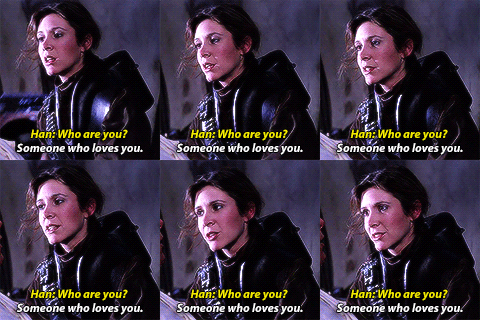
Something that helped was Kyle; he gave me something out of the ordinary to look forward to. Traveling to see him, having him travel to see me–they broke up the monotony. I had someone telling me that, hey, on the other side of the fog is someone who loves you, and you get to see him.

tumblr_mx09ajuucr1qe3cxyo8_250
(coming later: me analyzing this entire movie and the amazing way these two played this scene)

It helped. It helped a lot. And for a long time, I was out of that downswing. I finished my master’s degree, I started working, I got married, I started trying to get pregnant.

I don’t know if infertility increases the risk of postpartum depression, but I wouldn’t be surprised if it does, particularly because you’re afraid of losing what you’ve got, and that quickly turns into anxiety.

But I’m getting ahead of myself. My pregnancy with Sam was great, up until about the last four weeks. My body was SO done with being pregnant. My liver was the most frustrated with the situation and just sort of lost its fool mind. I ballooned up with excess fluid; my calves were so swollen that Kat and I spent many afternoons drawing pictures in my legs by just pressing down on the skin. I was physically miserable, and when I finally gave birth, I was relieved. So relieved. Within a day, I lost 30 pounds of water weight. Boom, gone.

gallery-1490046686-giphy
(late pregnancy in a nutshell)

Early motherhood didn’t come particularly easy for me. Some parts of it did; Sam was a delightful baby overall, a unicorn, really. He only fussed or cried if he was hungry or needed a diaper. He slept easily. He loved being held and was so curious about the world. He learned to smile at six weeks on the dot, and he learned to laugh about two weeks after that.

But other things were more difficult. Breastfeeding was hard. For the uninitiated, it involves so many more moving parts than you realize, and if your kid is not interested in latching, you’re up the crick without a padoodle, as my history teacher used to say when warning us to study for tests. And Sam? Sam did not want to latch. He didn’t want to breastfeed. He had no interest. He wanted to eat, that much was true, but he didn’t want to breastfeed at all. We ended up switching over to formula when he was two months old, and thank God we did.

And even with an easy unicorn baby, the transition from no baby to baby is difficult. You go from having moments to breathe, think, be yourself to having none. You go from understanding your body to inhabiting a monstrous form. Hell, you go from knowing when you need to use the toilet to peeing your pants because you didn’t know that you needed to use the toilet.

giphy2

And all the while, your body is having this enormous hormone crash. Everything that went into sustaining a human life for the last 40 weeks suddenly drops off, and your body flails in confusion, like what am I doing with myself anymore?

Your entire identity changes. You promise yourself beforehand that you won’t be one of those people who’s wholly consumed by motherhood and loses yourself, but in the first couple of months, you can’t do otherwise–unless you want to pass your baby off to a nanny or wetnurse and have done with it. The person you were before is gone, and if she does come back, it won’t be for a while.

So with all of that going on, it’s no wonder that postpartum depression and anxiety are huge things. It’s no wonder that, when you have a prior history of depression and anxiety, your doctor gives you pamphlets of things to look out for. The real wonder is that PPD/PPA numbers aren’t higher, and sometimes, I wonder if people just underreport.

The tipping point for me, the point where I decided to get help and end the fog and nausea, came about a week after my gallbladder surgery. I was at about 80%, health-wise, but I was still off-kilter and very high key anxious about everything. I was having panic attacks every night, lying in our queen-size bed by myself while Kyle slept in the living room with the baby so that I could rest and heal. My usual coping mechanisms weren’t working at all, and I didn’t know what to do.

It was a Sunday, and Kyle wanted to go to my parents’ house to do laundry, like we always did. I wasn’t going to join, because I still wasn’t feeling well, and Kyle wanted to leave the baby with me so that he could have some alone time for the first time that week (my parents were out of town). The idea of being left alone with the baby sent me into a panic. I didn’t know what to do. What would happen if a sudden complication from surgery came up and I got sick? What if I panicked and hurt the baby? What if I couldn’t do it? What if I took one of the vicodin they’d given me and it made me too tired to take care of the baby? What if? What if? What if?

I was shaking and crying, and Kyle said to me, “Look. I’ll take Sam with me, but you have to promise me that first thing tomorrow morning, you’ll call your doctor and use the words, ‘I think I have postpartum depression.’ Do you promise that you’ll do that?”

He had me backed into a corner in more ways than one. I promised.

And I got help. My doctor took one look at me and put me on one of the stronger antidepressants out there, venlafaxine (or Effexor). When the first dosage didn’t seem enough, she bumped me up and referred me to a therapist. I found things to look forward to, like moving into a new house, celebrating Sam’s birthday. I got a job so that the daily monotony could be broken up. I started to feel better.

I’m not out of the woods, honestly speaking. I still have days where I feel that fog coming back, and there are still things I need to work through. Lately, though, if I have one of those days, I’ve been drowning myself in Wet N’ Wild glitter and taking moments to think of what I have to look forward to: Sam’s birthday, trips to Texas, the hypothetical next child, etc. It’s a short term solution (and I do need to find myself a new therapist, though blogging helps a lot), but it works to break up the fog on all but the very worst days.

So here are my takeaways.

First, if you’re feeling that fog or that nausea, if you don’t think you have anything to look forward to or if you’re constantly afraid, you don’t have to feel that way. Talk to someone–call a doctor, find an online resource if you can’t speak with a doctor, talk to a friend or family member. Ask them to help you find something that shines through the fog so that you can keep going. Ask them to help you find your center again. Douse yourselves in glitter, and remember that depression and anxiety lie. Good things will happen again. Not everything in your future is bad, and you’re strong enough to withstand any bad that does come.

And second, if you know and love someone who’s dealing with that fog or nausea, help them. Talk to them. Give them something to look forward to. Sit with them when they panic. Help them find the strength to keep going. Step in and help them. Be the glitter for them.

tumblr_op6xyycqpv1vsjcxvo1_500